Showing posts with label opinion. Show all posts

Wednesday, August 3, 2022

It is a Matter of Trust.


I recently had an exchange with a friend where I noted our views were dependent on the trust one has in the public official making the statements.  His response was along the lines that trust is an antiquated concept.  I like these exchanges as it gives me something to think about. Indeed, is trust an antiquated concept?

As a military professional, I have a very hard time with the idea trust has gone out of fashion. During my career, the lives of the men and women I served with, and who I led lived, and occasionally died, based on the trust we had in each other, and the commanders who directed us.  The entirety of the combat arms of this nation is built on the expectation of trust. We will do the right thing, and if we don’t, we will be ostracized and removed.

In the elite forces, like the US Navy’s SEALs, the US Army’s Special Forces/Rangers, and the US Air Force’s Special Tactics the whole concept of trust is taken to the highest level, but even the average soldier, sailor, Marine, and airman build their career and their lives on trusting those to their left and right.  As a flyer, we place our trust in the maintainers who inspect and repair the aircraft prior to our flight. For us trust is absolute, without it we are nothing.

Now we turn to politics and society outside the military. Is it true in our society and within our political system that trust is an antiquated concept?

While it is true, that we’ve become polarized in our political divisions, at the end of the day the individuals of society do, in fact, place their trust in the words and deeds of the political factions they support.  If they did not our elections would have participation rates well below 50%. As it stands, we don’t do a great job turning out to vote, but our historical average remains above that threshold.

When a political party calls for civic outrage based solely on the rhetoric of the party, we still see that outrage turned into action on the streets, based on shared ideals and the belief that outrage will affect change as promised by the politicians. That alone confirms the trust of party loyalists that their political representatives know what they are doing.

Doing business in today’s world is almost always a matter of trust. We trust the food we buy to be safe to eat. The medicines we take to improve our health, and the products we buy to be delivered and work as promised.  Unfortunately, political involvement and agendas have begun to erode that trust, but without it can our system survive? I believe for most of us the majority of that trust in the “system” remains, while trust in some “experts” may be waning.

It seems to me that trust is the essential ingredient in our educational system. We send our children off to school with the trust the educators will do their best to impart the essential knowledge as they prepare them to enter society. Unfortunately, this does appear to be one area where the idea of trust has been violated and now parents are coming to grips with the agendas that are driving the school systems and the teachers to impart more than the essential skills of academics with their own social mores, rather than leave that to the parents.

What the shutdown of our society during the recent pandemic has shown many parents is the subversive nature of the professional educators as they transition from strictly the role of educator to social indoctrination. Perhaps this is a long-standing approach, but its impacts became most evident with the rise of social media like Facebook, Twitter, and TikTok. Now, as parents seek to regain control of what their children’s education should look like, there is an emerging battleground between professional educators and the family.  I am not involved enough to know with certainty, but as an outsider, it would seem the activists on both sides are driving this confrontation. Unfortunately, it will be the children who are most hurt by this loss of trust.

Perhaps, my friend who comes from this educational background bases his belief that trust is an antiquated concept on that conflict. If so, that is unfortunate.

But then as I consider his words, I am struck by the loss of trust we have developed in our judicial system where equality under the law and protection of society from the wolves who would feed on it is essential.  We see much in the news to drive us to outrage regardless of our political beliefs so perhaps my friend is right, especially when we talk about a nation where respect for the law is the underpinning of our entire society. 

I guess time will tell if trust is really as antiquated as my friend believes.

Thursday, June 9, 2022

What is Truth?


For most of us, this seems a relatively simple question.  Truth is factually correct information.  But is it?  How do we separate truth from fiction, or fact from opinion? In this age of an overabundance of data, sorting through this to find the truth is a daunting task, and one most of us can’t be bothered with. We tend to take shortcuts to find an answer we like, rather than wonder about the truth. 

A quick search of the question, (what is truth?) returns some interesting perspectives.  From a religious standpoint, we can find: “Truth is a self-expression of God.”  Psychology Today says: “Truth is a property not so much of thoughts and ideas but more properly of beliefs and assertions.” Then, of course, you have the exchange between Tom Cruise and Jack Nicholson in the movie “A Few Good Men.”

But what happens to society when people no longer believe in the institutions we’ve developed to provide for a stable social construct? 

Does the court system deal in truth? Perhaps, but in our advocacy system, the defense is actually charged with obscuring the facts to present an alternative version of reality. So, in a sense, it is left to the jury to decide what is true and what is not.  Sometimes they get it right, sometimes they don’t.

Does the entertainment industry deal in truth? I think most would agree it does not. But we seek those whose celebrity comes from that industry to tell us what is true. This leads me to a core problem with our social construct today. Is the way we receive our information from a fact-based system, or an entertainment-based one? Are any of the public “news” channels focused on truth, or do they only offer the opinions they believe will draw the greatest number of viewers?

We talk about our first amendment right to “free speech” but the constitution only places limits on what rules the government can implement, and the idea of “free speech” will mean not all speech is true. Whose job is it to decide what is true and what is not? The most recent pandemic of COVID-19 played out against this backdrop. There were politicians, activists, entertainers, and experts all weighing in on what was true. For the average person, it fell down to who could, or should, you believe?

As the virus played out in its mutating forms we saw, in real time, the struggle to control the flow of information and the increasing polarization of opinions based not on a seeking of the truth, but on the control of the population, allegedly to control the virus. Did it work?  I’m not sure how you could possibly tell that one method was superior to another since, as far as I can tell, seeking truth was never an objective.  What I do know is as of today, here in the United States, there is a statistically insignificant difference between states that exerted maximum control of the populations, and states that began to ease restrictions as soon as they could.  The top four most populous states in the nation are California, Texas, Florida, and New York.  The top four states in the nation for COVID deaths are California, Texas, Florida, and New York.

As we look towards our government and social media, do the institutions operate to provide truth, or do they operate to control and limit power?  What is the truth?


Wednesday, April 7, 2021

What is it About All These "ISMs?"

I was reading this morning and it occurred to me we’ve created a lot of “isms.”  You know all those really cool things people like to opine on.  We have Feminism, Popularism, Nationalism, Globalism, and of course Racism.  All of these “isms” seem to be good things to have opinions on, but at the same time, none of them seem to have a universally agreed definition that applies to all members of society.  Why is that?

For example, there are “feminist” women who believe women should be equal to men, but can’t define what equality actually means.  Should men and women compete in sports whereas of today women would seem to have a disadvantage when it comes to strength and speed, or should there be similar competitions for men and women with equal prizes?  Why don’t women golfers make the same money as their male counterparts, even though revenue from their events seems to be lower than in the men’s tournaments?  


But then we have feminists who think women are superior to men and it is only through the chauvinist nature of society that women are prevented from showing that superiority.  Which feminist is right or is there no right?

The same can be said about Popularism.  Who can truly define what the legitimate popularist movement is?  On the one side, we have a minority of hardcore conservatives who believe the Trump movement was a popularist uprising.  On the other, we have a minority of hardcore radicals who believe ANTIFA and BLM represent the populist uprising.  Of course, the Democratic party, the party of hate, has long played this game on how best to divide the country to maintain its power, while the Republican Party, the party of greed, has stumbled about trying to keep up with their political opponents.  From a strictly legal perspective, I’ve got to put my money on the legitimacy of the Trump movement as being more mainstream since most Trump supporters are not destroying the towns and cities, they live in.

Is nationalism good or bad?  I was brought up thinking it was good.  I joined the military to see the world and protect the nation (actually in that order) and thought I was doing a good thing.  Now I’m told nationalism is bad and we should all agree globalism is the way to go, although it doesn’t appear to hold worldwide appeal, at least in places like China.

Finally, what is up with Racism?  We didn’t hear a great deal about how racist we all were, at least us white folks, until President Obama decided to choose sides in isolated local events was a good thing.  Now with the transmogrification of Critical Race Theory into a social justice standard it is widely accepted that only old white conservative males are racist and everyone else just wants to get along peacefully.  Although somewhere along the line the inner-city youth may have missed the memos since they seem to beat up and kill a lot of people who are not old white conservative males.

So my real question is, is the world better for discovering all these cool “isms?”

Saturday, March 27, 2021

There Was a Time

My life has been interesting.  There was a time I was a social liberal, but at that time I always thought it was about doing the right thing.  I joined the military for the sense of adventure and because I felt an obligation to give back to a country, which afforded me the opportunity. I was a distinct minority even then.

I thought things like social security and welfare were good ideas, as long as we could afford them within the fiscal realities of the nation.  But over time I’ve come to realize they are only tools used by the politicians to gain and increase control of the populations so they can enrich themselves.  Today, we see the two political parties dueling with each other, again so they can continue to enrich themselves.

If we look at welfare with an unjaded view what do we see?  With over 60-years of experience have we eliminated poverty, or just made poverty more expensive?  With over 60-years of Medicare and Medicaid have we made medicine more accessible for the poor or simply more expensive?  Meanwhile, we enrich those who’ve found ways to make their fortunes from the government dollars.

There was a time when a liberal saw the possibilities of the world and could argue for their advancement and support.  Today’s liberals have no great ideas that don’t involve the surrender of our personal liberties.  They no longer believe in personal responsibility or individual ability as the keys to success, they cry out for reparations and government largess from those who would spend someone else’s fortune to make right the perception of social injustice, as defined by some academic theory originated by someone with an advanced degree in some social science or gender studies program. 

Over the course of my life, I’ve seen the greed of men and women destroy good ideas for the sake of individual gain.  I’ve seen profiteering from conflict lead our politicians into rash action which has cost thousands of lives as we take personal liberties away in the name of safety.  And when someone comes into the power elite from the outside both sides band together to vilify him so the threat to their wealth and power is stalemated.  

We no longer have young who can think for themselves, and perhaps we never did.  For thinking requires wisdom, not just the illusion of knowing it all.  

There was a time before everything was a meme when men and women had great ideas and some of those great ideas made us a nation unlike any other.  Now we just sink into the realm of bickering where our politicians argue for sound bites and neither side proposes real ideas, they just argue about the stupidity of the other side.  A time where the flow of information is controlled and the exchange of ideas is nonexistent.  

Saturday, February 27, 2021

Black History Month

I’m all for celebrating the accomplishments of African-Americans, African-Europeans, African-Asians, African-Australians, African-Antarcticians, and African-Africans with a month dedicated to their contributions to society, but it does make me wonder a bit about the writing of our history and modern accomplishments of the race.

For example, are my local television news broadcasts racist?  As I watch the nightly news from time to time, I am struck by how one-sided their stories are when it comes to showing the faces of people who are arrested for murder, assault, theft, or drug use.  Proportionally, African-Americans account for about 17%[1] of the state population in Florida yet in broadcasting the most egregious crime reports I see about 90% of those reports involve African-Americans. Perhaps this is just my perception but in looking at the FBI analysis[2] it seems to me for a minority population (nationally about 16%) the number of violent crimes they commit seems to far outweigh the other races.  In looking at total arrests in 2018 blacks were arrested for about 27% of them with Murder/Manslaughter and Robbery exceeding the other populations.  Why is that?  Is it the entirety of law enforcement is racists, as the Black Lives Matter organization would have us believe, or is there a systemic failure within the black community?

Have we, the unhyphenated-Americans, done something or failed to do something which may have caused a systemic failure to raise confident and successful young black men?  I am unconvinced by the social justice theories regarding Critical Race, or White Privilege, they may speak to specific acts, but for the most part, they attempt to eliminate personal responsibility from those who fail.  Accepting the idea that failure is never the individuals' fault flies in the face of over 5,000 years of human history. Those who’ve succeeded in their lives have never accepted that as a reason to not pursue excellence, so why would we as a society?

 A lot of people with much larger voices than I have certainly weighed in on this, but as I look at those voices there is always an underlying motive for those opinions.  Just as there is with mine.  The difference is I seek no power from my opinion while those with the loudest voices certainly do.  I will use Al Sharpton[3] as an example.  Starting out from his upbringing in Brooklyn he became a Baptist minister and advocate in the race issues of the 1970s and 80s.  But history has proven him to be before all else an opportunist who has enriched himself during his campaigns to allegedly help the helpless.  The case of Twana Brawley stands out as an example of this.

As I said earlier, I am all for celebrating the accomplishments of successful people of color, but when the career of Supreme Court Justice Clarence Thomas is discounted and someone like George Floyd is held up as the reason for the destruction of a city I have to question the legitimacy and value of the month.

Monday, February 1, 2021

A Black Life That Mattered

I saw a story on a Friend’s FB post and it gave me pause to consider the current social controversy over the BLM movement.  Sadly, we do such a poor job actually teaching our young history this is all too common.  We set curriculum by “Education Professionals” who serve up their own agenda, pushed upon teachers who then put their own bias into place, and at the end of the day, it seems, at least to me, much easier to teach what is wrong with history rather than what some truly remarkable individuals did to shape it. 

This link is the story of Eugene J. Bullard.  A person of color who escaped the racism of the United States to become a hero of France.  The link above paints a simple story of Mr. Bullard, but the story I saw on FaceBook was much more vibrant.  It was written by Will Stenberg.

 The Black Sparrow

Will Stenberg

“They called him the Black Sparrow, and from the beginning of his life, all he wanted to do was get to France. He was born in Georgia, his father a former slave from Haiti, his mother full-blooded Creek. He ran away while still a child, determined to fulfill his destiny.

He lived for a time with a group of English Romani, learning the art of horsemanship and working as a jockey. He kept traveling and working until he made his way to Norfolk, where he stowed away on a ship bound for Scotland. He wouldn't see America again for thirty years

In Glasgow he got work as a lookout for gambling operators, saving money until he had enough to get to England: one country closer to his goal. In Liverpool, he did hard labor until his muscles developed and he turned to box. He became part of a whole ex-pat community of Black boxers — some of the finest fighters in history — who had fled to Europe to find opportunities denied them in the States. Soon he was fighting regularly as a welterweight, racking up an impressive record, even fighting on the undercard of a few Jack Johnson bouts. His boxing career earned him a decent amount of money, and eventually took him to Paris, where he won his bout and promptly hopped off the tour.

He was home. 

Imagine, if you will, being a young, handsome Black/Creek man, son of a slave, escaped from the American South, newly arrived in Paris in the springtime with your own apartment and a pocketful of money. Then imagine it is 1914.

Fighting for France was a no-brainer. After all, in his heart at least, it was his country. He joined the French Foreign Legion, training to fight in the 3rd Marching Division alongside wealthy Ivy Leaguers, mariners, farmers, doctors, executives, refugees, cooks, and plenty of characters from all over the world running from undisclosed situations. These were Belgians, Italians, Russians, Greeks, Americans, a handful of Black Americans; Muslims, Catholics, Jews, and Protestants — the legendary rabble of the Legion.

Sent directly to the front along the Somme, he was thrust into a world of filthy, bloody trenches still filled with the body parts of the dead and the rancid smell of shit and blood as his unit experienced some of the worst losses of the war.  At the end of this stint, what was left of the 3rd was disbanded and he had only the briefest respite before he joined the 170th Cavalry and was sent straight to Verdun to participate in what would become one of the worst battles in the history of the human race.

Now a corporal, he led a machine-gun crew and again was front-and-center for the worst of the fighting, suffering first a shrapnel wound to the face that he simply fought through, then finally sidelined by a massive, nearly fatal wound to his thigh that finally sent him away from the front.  Decorated with the Croix de Guerre for his valor at Verdun — one of France’s highest military honors — he was well within his rights to find a desk job in the military. He had other ideas. He wanted to fly

Already viewed as a hero, he was able to pull the necessary strings to enter flight school and became the first Black American fighter pilot in history. He flew a SPAD VII C1 with a distinctive alteration to its appearance. Painted on the outside of the fuselage was a red heart with a dagger through it. Above the heart was his personal slogan, one he would later use for the title of his unpublished memoir: Tout Le Sang Qui Coule Est Rouge; roughly, in English: “All Blood Runs Red.”

He flew with honor and distinction until his career in the air came to an abrupt halt. The Americans had entered the war and the involvement of a certain Dr. Gros, a US Army Major with racist attitudes, led to the end of the Black Sparrow's career as a pilot. 

But the French continued to celebrate him. He ended this part of his military career with the Military Medal, Croix de Guerre, Volunteer Combat Cross, Medal for Military Wounded (twice), World War I Medal, Victory Medal, Voluntary Enlistment Medal, Battle of Verdun Medal, Battle of Somme Medal, and the American Volunteer with the French Army Medal.

And that is when his life got interesting.

The Great War over, he found himself in Paris in the 1920s at the onset of the Jazz Age. He got back in shape, took work as a sparring partner, and fought a few more times. But it wasn't sustainable with his injuries.

So he learned to play the drums and became a jazz musician. He gigged frequently, saved money, and ended up in a business partnership with a biracial American blues singer whose birth name was Ada Beatrice Queen Victoria Louis Virginia Smith — known as "Bricktop" for her red hair. Together, they opened the Le Grand Duc, and thus he became proprietor of the hippest nightclub in the hippest city during the birth of hip.

He got married around this time to a Frenchwoman named Marcelle and they had two daughters. For reasons that remained private, Marcelle ended up leaving him with their children, to whom he would remain devoted for the rest of his life, as we will see. But he had to balance the duties of being a single parent with Le Grand Duc — and later his other club, L’escradille, which was connected to a boxing gym so that patrons could party, then exercise, take a steam bath, get a massage, and start partying again

To name the personages that frequented his clubs is basically to list the greatest names in art and culture in the renaissance that was the 1920s. Langston Hughes was a busboy and dishwasher. Arthur Wilson — you may know him as "Sam" of Casablanca fame — was part of the house band. Charlie Chaplin was a favorite. Gloria Swanson. Fatty Arbuckle. The Prince of Wales. Staff would move tables when Fred and Adele Astaire came in to tear up the floor. Picasso would stop by, and Hemingway was there often enough that he wrote about it in "The Sun Also Rises." Josephine Baker could not be missed and even babysat for the Sparrow. F. Scott Fitzgerald and Zelda were frequent, notorious guests. Cole Porter would come in; he adored the way Bricktop interpreted his songs. When Louis Armstrong encamped in Paris, he and the Sparrow became close

But the good times couldn't last. In 1933, Hitler was appointed Chancellor of Germany. In France, the Deuxième Bureau was created as a counter-intelligence service, and the Sparrow was recruited to work with the beautiful Alsatian spy, Cleopatra "Kitty" Terrier, whose father's murder by Germans in the disputed border region had instilled in her a lifelong hatred of German expansionism.

Kitty and the Sparrow worked as a team at the club. He would serve tables and play dumb, exploiting German prejudices that would never suspect he was fluent in German. She would flirt her way into privileged information. It was a highly successful (and probably romantic) pairing, but with rationing, blackouts, and other wartime austerity measures, keeping businesses running became harder and harder.

He tried. He procured a wagon and would visit markets at the end of the day for discounted goods, throw them in a stew at the club. Come evening he would feed everyone for free, plus a free glass of wine per person and a pack of cigarettes per table. He tried. But of course, things got worse.

He pulled his daughters out of their convent school to keep them close. Closed the club. Many were fleeing as the Nazis came storming through Belgium. He wouldn't run. He continued to work with Kitty in the Resistance until 1940 when the Nazis marched down Champs-Élysées and through L'arc de Triomphe.

Tens of thousands fled the city only to be bombed from the skies. He left his daughters in the care of Kitty, who promised to do what was necessary to keep them safe, packed his gear, and headed for the frontlines, determined, despite his age and multiple injuries, to find his old unit and rejoin the Legion. When he arrived, it was only to find that his unit had been destroyed. Returning to Paris, he couldn't enter; it had been completely overrun.

But he heard rumors that the French 51st was holding out at Orléans. He started off on foot. The roads were full of starved, half-mad refugees. Bombings were frequent. When he got there he discovered that his lieutenant from the last war was the commander of the 51st, and, in what must have felt like the world's worst case of déjà vu, he was once again in charge of a machine-gun crew, fighting the Germans. He fought with his usual bravery. But it was a hopeless last stand. A shell that killed 11 men threw him forty feet and cracked a vertebra.

His fighting days were over. Using his rifle as a crutch, he struck out for a military hospital in Angoulême, trying to stay out of sight.  But there was little they could do for him there: painkillers, some bandages, and a few cans of sardines with a suggestion to head for Bordeaux and into Spain which, although Fascist, had maintained official neutrality, and was tacitly allowing Allied rescue efforts on Spanish soil.

He made it, somehow, received his first passport, and was put on a Navy ship to finally return to the United States he had fled decades before.

Life in Manhattan wasn't easy. He had to start from scratch. He worked odd jobs — longshoreman, salesman of French perfume. Through a contact in the State Department, he was able to get in touch with Kitty, who was true to her word: his daughters were safe. They came to the States without a word of English between them and moved in with their beloved father in Spanish Harlem.

He became involved in Free French groups, working to support General de Gaulle, head of the Free French government in exile, and was also filmed getting beaten by police as part of a human chain to protect Paul Robeson when his concert was disrupted by white supremacists. Times were tight but he was doing okay. His old friend Louis Armstrong came to help, hiring him as a tour manager and occasional drummer. He even tried to recover his club and gym in Paris, but the postwar situation was hopelessly complicated and he had to give up.

In 1959, via the French Embassy in New York City, he was made a chevalier (knight) of France. He said at the ceremony, "My services to France could never repay all I owe her.”

Working at the time as an elevator operator at 10 Rockefeller Plaza, he was wearing his medal on his work uniform when Dave Garroway, the host of The Tonight Show, asked him about it. Naturally amazed by what he heard, Garroway saw that this elegant elevator operator got the day off of work so he could come to his office for an interview

It took a week to confirm facts. They all checked out: the elevator man at 10 Rockefeller Plaza was the first Black American fighter pilot in history — and a lot more.

He appeared on The Today Show, which led to a slew of other appearances and speaking engagements. At least in parts of America, he became a celebrated figure, his heroism recognized. 

During his one return visit to Georgia, though, things were not so bright. His family has been scattered. One brother had been lynched by squatters when he'd tried to recover ancestral Creek land.

He never returned to the South, living out the rest of his life in New York City. But there was one final honor.

In 1960, General Charles de Gaulle, leader of Free France, came to visit Eisenhower. A million people greeted him in the streets when he arrived in New York. Hundreds of children sang "La Marseillaise." He gave speeches at City Hall and the Waldorf Astoria, then went where he truly belonged, to the Seventh Regiment Armory. Five thousand French were there. And the Sparrow. His presence had been requested

After de Gaulle's speech, he looked into the crowd as though searching for a friend. The thousands gathered, and assembled press may have wondered what was going on as the general left the podium and headed into the sea of faces to find a lone Black man, his chest gleaming with medals.

The man stood at attention and saluted. De Gaulle returned the salute.

Then the general stuck out his hand and, when it was received, pulled the old soldier into a massive hug

"All our country is in your debt," he said. 

Crying, the man whose journey began as a stowaway, bound for an uncertain future, sure only that he belonged in France, could only respond, "Merci, mon general. Merci beaucoup."

Not long after, he entered the hospital with stomach pains. He'd been ignoring them, but the insistence of his daughters finally prevailed.

The cancer was advanced. He turned 66 on October 9, 1961, and died on the 12th

The woman who had been helping him with his memoirs visited him on the day he died. She was crying at the bedside where he lay, seemingly lost to the world he was leaving. Hearing her sobs, his consciousness returned from wherever it had been.

He pulled the tube out of his mouth. He had something he wanted to say to her.

The old horseman, boxer, soldier, pilot, spy, club-owner, musician, and father turned to his friend and smiled. ‘Don't fret, honey,’ he said. ‘It's easy.’

His name was Eugene Bullard --They called him the Black Sparrow.”

I find it sad a modern organization that claims Black Lives Matter chooses to represent itself with people whose lives are on the margin through their choices.  Of course, in these days of rationalization, it is never the individual choice that caused the marginalization it was some societal ill.  Yet, we have example after example of people of color who made remarkable differences to the lives of thousand when the racism of America was far worse than today and those names are allowed to be buried under the ruble of protest.

We are entering into the sixth decade of the Great Society, where the government has implemented program after program to make life better for the poor.  Yet no one is willing to actually talk about the destruction of the African-American communities as their families are destroyed, their role models shifted from men like Eugene Bullard to the leaders of gangs and cartels, and children are murdered on the streets by the violence that has become their lives.

Just a thought, but maybe the best intentions of a government whose moral values center on individual wealth and power isn’t the answer.

Friday, January 22, 2021

From Lewis Carroll to Today

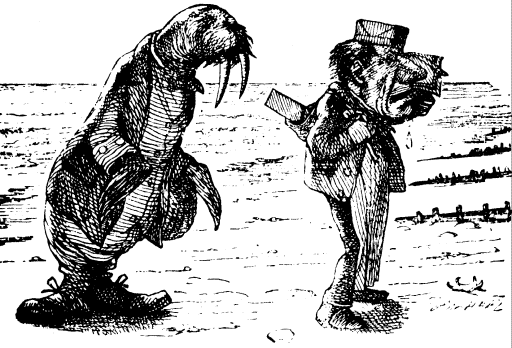
In my youth, I learned a segment of a poem written by Lewis Carroll.  It comes from his most famous work, “Through the Looking Glass and What Alice Found There, published in 1872. That brief snippet of the poem has stayed with me these many decades.  But the poem, in its entirety, seems to offer an analogy to the politics we oysters have chosen for ourselves. 


The Walrus and The Carpenter


The sun was shining on the sea,
Shining with all his might:
He did his very best to make
The billows smooth and bright--
And this was odd, because it was
The middle of the night.

The moon was shining sulkily,
Because she thought the sun
Had got no business to be there
After the day was done--
"It's very rude of him," she said,
"To come and spoil the fun!"

The sea was wet as wet could be,
The sands were dry as dry.
You could not see a cloud, because
No cloud was in the sky:
No birds were flying overhead--
There were no birds to fly.

The Walrus and the Carpenter
Were walking close at hand;
They wept like anything to see
Such quantities of sand:
"If this were only cleared away,"
They said, "it would be grand!"

"If seven maids with seven mops
Swept it for half a year.
Do you suppose," the Walrus said,
"That they could get it clear?"
"I doubt it," said the Carpenter,
And shed a bitter tear.

"O Oysters, come and walk with us!"
The Walrus did beseech.
"A pleasant walk, a pleasant talk,
Along the briny beach:
We cannot do with more than four,
To give a hand to each."

The eldest Oyster looked at him,
But never a word he said:
The eldest Oyster winked his eye,
And shook his heavy head--
Meaning to say he did not choose
To leave the oyster-bed.

But four young Oysters hurried up,
All eager for the treat:
Their coats were brushed, their faces washed,
Their shoes were clean and neat--
And this was odd, because, you know,
They hadn't any feet.

Four other Oysters followed them,
And yet another four;
And thick and fast they came at last,
And more, and more, and more--
All hopping through the frothy waves,
And scrambling to the shore.

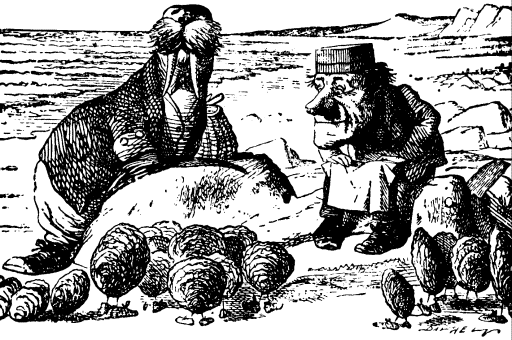
The Walrus and the Carpenter
Walked on a mile or so,
And then they rested on a rock
Conveniently low:
And all the little Oysters stood
And waited in a row.

"The time has come," the Walrus said,
"To talk of many things:
Of shoes--and ships--and sealing-wax--
Of cabbages--and kings--
And why the sea is boiling hot--
And whether pigs have wings."

"But wait a bit," the Oysters cried,
"Before we have our chat;
For some of us are out of breath,
And all of us are fat!"
"No hurry!" said the Carpenter.
They thanked him much for that.

"A loaf of bread," the Walrus said,
"Is what we chiefly need:
Pepper and vinegar besides
Are very good indeed--
Now if you're ready, Oysters dear,
We can begin to feed."

"But not on us!" the Oysters cried,
Turning a little blue.
"After such kindness, that would be
A dismal thing to do!"
"The night is fine," the Walrus said.
"Do you admire the view?

"It was so kind of you to come!
And you are very nice!"
The Carpenter said nothing but
"Cut us another slice:
I wish you were not quite so deaf--
I've had to ask you twice!"

"It seems a shame," the Walrus said,
"To play them such a trick,
After we've brought them out so far,
And made them trot so quick!"
The Carpenter said nothing but
"The butter's spread too thick!"

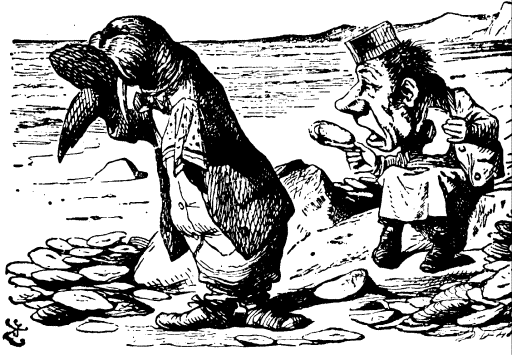
"I weep for you," the Walrus said:
"I deeply sympathize."
With sobs and tears he sorted out
Those of the largest size,
Holding his pocket-handkerchief
Before his streaming eyes.

"O Oysters," said the Carpenter,
"You've had a pleasant run!
Shall we be trotting home again?'
But answer came there none--
And this was scarcely odd, because
They'd eaten every one.

Friday, September 11, 2020

A Few Thoughts on COVID-19


Before I start, I’d like to review some factual numbers most can agree with.  First, I’ll start with the 1918 H1N1 (“Spanish”) flu.

There were actually three waves of the flu.  The initial wave was in the first half of 1918, the second, and deadliest was October to December 1918, and the third was in the Spring of 1919.

It is estimated between 50 and 100 million people died and perhaps 500 million people contacted it.  (World population at the time was about 1.5 billion, so almost 1/3 of the world came down with the illness.)

We like to believe science was not as advanced in the day, and perhaps that is true, but the interesting takeaway, at least for me, is widespread immunization was not practiced and had no impact in lessening the outbreaks.[1]

All that is background.  This isn’t 1918, its 100 years later, and the “claims of science” now drive the news and individual choices/decisions.

The novel coronavirus, (AKA COVID-19, China Virus, Wuhan Virus, and SARS-CoV-2) is this year’s pandemic and in an effort to avoid the devastation of the 1918 H1N1 most of the western nations have gone to the extreme of demanding their citizens remain in isolation and have effectively shut down the economies in the hopes of letting the virus play itself out through lack of social interaction.

As of today, there have been 28,292,846 cases worldwide, of which 6,431,885 have been in the U.S.  From a mortality rate, 911,770 deaths, with of which 192, 663 have been here.

It appears, at least on paper, China, where the virus originated, has been far more successful by just stopping the reporting on the number of ill and dying people. Nobody in the media seems at all interested in actually challenging that approach so it must be okay.

So, has the approach of the world been effective?  The answer is a resounding – maybe, kinda, sort of.

It looked like we in the US had the virus under control and then we began to reopen the economy and BOOM, the cases grew!  States that had horrific death rates remained locked down and their cases remained low.  We are now seeing the same kinds of things in Europe.  Spain which had a terrible experience and went into almost complete lock-down now has among the highest rate of infections.  As a way of explanation, effective 9/11/2020, the USA has a rate of 8,447 cases per million, while Spain has a rate of 12,418/1M[2]

Ultimately, the question for all of us is what is the acceptable level of risk for us as individuals and for a society?

For some, that number appears to be zero, but that will never be achieved.  Even when an effective immunization comes out, we can expect to see both adverse reactions to the immunization as well as immunizations that seem to have been ineffective.  For the majority though there will be benefit.

For others, that level of acceptable risks seems to be at the levels of mortality we see today.  According to the World Health Organization that number should be 3.6%.  Today in the U.S. we are at 3%, and here in FL we are actually at 1.9%[3].  So, while the media will shout about the number of cases we have, for me the real concern should be what is the probability it will take a life?  In that sense it truly does appear we’ve turned the corner on this pandemic.

As each of us decide what is best for us individually, the one thing I’ve seen as this became a political issue, rather than simply a medical problem, is how one’s political belief in the power of their party’s recommendations is reflected in how they accept risk, both for themselves and for others.  From a social perspective that seems a bit crazy, but in a polarized world I guess it is to be expected.

I respect each person’s choice, whether it is to remain cloistered away, wear a mask in limited public excursions, or attempt to return to a fully social life within the guidelines of the state.  Sadly, that acceptance does not seem to be a common approach for all.

Sunday, August 2, 2020

Just An Opinion


What follows isn’t an endorsement, nor is it a condemnation.  It is simply my opinion on the choices before the nation in the upcoming election.  They may be coherent and compelling to some, and completely off-putting to others.  Be that as it may.  What got me thinking about this was President Trump's latest shot on Twitter to outrage the DNC, their media arm in the mainstream media, and a plethora of political talking/writing heads.  There is also a posting on  Althouse, talking about wokeness that ties into this whole thing.

I can think of a half dozen, or perhaps more, reasons not to vote for President Trump’s reelection.  Almost all of them center on the character of the man.  At the same time, I can’t come up with a single reason to vote for his opponent, the former Senator and Vice President, Joe Biden.  For me, this is a slightly different dynamic than we had in 2016 where both candidates carried the baggage of their negatives and for most, it required ignoring those negatives completely to vote for the party of their choice.  Predictably the votes in the urban areas went to the Democrat, and in the rural areas to the Republican.  What made The Donald’s election possible was the failure of the DNC (and candidate Clinton) to recognize how much weight his message carried for the union members who had watched their jobs go overseas for close to 30 years, and an assumption the minority voter would turn out for her as they did for President Obama.

Since his election, the President has faced a constant barrage of criticism on his handling of the job. Almost all that criticism comes from the agenda-driven opposition and is obviously politically motivated. Although the President seems to relish the attention it brings. It is as if he is the modern-day embodiment of Phineas T. Barnum.

What I see is just the natural evolution of mean-spirited political rhetoric that brought Donald Trump to the head of the GOP field and ultimately the election.  It is, again in my opinion, fueled by the meanness and self-righteousness we’ve come to expect on our social and entertainment outlets. Profanity is the new normal of our entertainment choices, and we see it play out in unwarranted outrage over even the most minor of civil conflicts.

For right or wrong President Trump now represents the status quo.  He is the embodiment of a continuation of the nation we’ve become.  His opponent is the face of a party that is willing to sacrifice all we’ve become simply to regain the power it lost with the 2016 election and partially regained in 2018.  It sees its future in the extremes of the millennials who seek to destroy our history.  A generation who has been taught that hate is okay as long as it is used for their causes. Violence to achieve those goals is the way society should be.  Lying is just a natural evolution in the transition to relative morality.  One has only to look at how the groups they hold as examples of youth involvement engage with the political realities to see this violence play out. 

Of course, the propaganda arms of the BLM and ANTIFA movements are there to persuade the population that what you see on the nightly news isn’t their fault, they are simply reacting to violence of the establishment.  It is, after all, President Trump's fault that cities that have been controlled since the 1970s by the Democrats are racist because the GOP and President Trump are fascists.

Tuesday, June 30, 2020

Can the Right Cause Bring You Salvation?


Some believe if they choose the right causes to support, they are doing the will of God and will be rewarded for their choice.  Some reject the concept of God, but in so doing also believe their support of the right causes will make them the more valued in society and their good works will be rewarded.  It is as if they don’t understand that causes are the public face of those who seek or wish to retain power. 
Causes are the means to gain wealth to do something or perhaps just to give the illusion of doing something while gaining wealth.  There isn’t any great mystery to this and you can choose almost any “cause” you want; to see the truth in this statement.  It could be as obvious as the Clinton Foundation, or as subtle as the World Wildlife Foundation.  Some causes do great work, but most actually enrich a few central characters.
Atheists love to point out the wealth schemes of the churches.  Schemes ranging from the megachurches of Jim and Tammy Faye Baker, or now The Lakewood Church of Joel Osteen; to the Roman Catholic Church of Rome, but we Americans have so much disposable wealth we seek to find forgiveness of our sins by contributing to the right causes.
The American Red Cross is a great cause.  Its volunteers are there to assist in times of disaster and provide aid and assistance when it’s needed.  But let’s look at what Charity Navigator has to say about the organization and some of its franchises. 
The national organization, headquartered in Washington DC commits almost 90% of its donations to organizational programs (this is a good thing), while 3.7% goes to administrative costs and 6.3% of its funds are rolled back into seeking new donations.  It has an annual revenue of almost $3 billion.  But other organizations within the ARC family are not quite so stellar.  The American Red Cross of Washington (state) and Seattle have both been indicted by the state’s Attorney General for ties to organized crimes.
How about the Black Lives Matter Foundation?  Subject to a cease and desist order by the California Attorney General it has raised millions but is supposedly not affiliated by the BLM cause.
You can certainly use your personal wealth as you wish, but remember contributing to the right cause will not gain you one iota of benefit beyond a sense of personal satisfaction.  As we learn in Ephesians.
“For it is by grace you have been saved through faith, and this not from yourselves; it is the gift of God, not by works so no one can boast. For we are God’s workmanship, created in Christ Jesus to do good works, which God prepared in advance as our way of life.”           

Thursday, June 18, 2020

The New Morality


I Don’t Know Where to Start.
I see our civil behavior spinning out of control as mobs become the angry voice as people charged with being leaders bend over to appease the mob.  The liberal/progressive/socialists and conservative/status quo/capitalist leaders of our society have abrogated any sort of balance in social discourse and they now bemoan the fact we are uncivil. 
The educational system has moved so far off-center in this country that we see only one side of the political debate allowed on most university campuses.  Professors are now more concerned with indoctrinating the minds they influence than in actually creating in them the ability to question what they see and judge for themselves.  The attempts to have professors who disagree with the outrage of the Black Lives Matter movement fired and the denial of admittance of young minds with dissenting opinions into the universities are just two examples of this trend.
Each side is now so entrenched in their own moral superiority that there can be no compromise.  The idea of identity politics is so prevalent that we pick our heroes based on whatever media outlet we like shows us about them.  We don’t want to see the whole story; we want to hear only what we already believe.  A company supports a cause we don’t like, by God, we need to boycott their product.  An industry CEO says something we disagree with, he/she must be eliminated. 
Those who support the destruction of civil war statues buy-in completely with the views of the Southern Poverty Law Center that these statues were erected to intimidate the black community during the era of Jim Crow.  They find the destruction of public property, without any kind of legal process, to be perfectly fine.  What they can’t define is what is acceptable and what is unacceptable from a destruction standpoint. 
It is not very different than the on-going debate over gun ownership.  The why of erecting the statues is long gone.  The statues are inanimate objects they have no voice, except the voices of those who want to inflame the passions of the mobs (both left and right).  If we ignore those voices they eventually tire and turn into whispers, but we can’t do that.  The media won’t allow it.  A gathering of a few dozen angry bigots becomes national news.  We must all join into the groupthink of outrage.
Where does society draw the line?  What is the acceptable level of hate and vitriol?  Why stop at the tearing down of Civil War reminders?  Why not destroy all the memorials to those who created this country.  Jefferson Davis has a home in Biloxi, shouldn’t we burn it to the ground?  Andrew Jackson started the Democratic Party that encouraged and supported the South to wage a war of separation, shouldn’t all his statues be destroyed?  How about Thomas Jefferson and George Washington?  They have homes in Virginia and monuments in Washington.  They both were slave owners; we can’t celebrate their contributions to the nation.  We must destroy all traces of them.
But why stop there.  Columbus brought Europeans to the continent and ruined the lives of countless thousands who were killed by the Spanish, Portuguese, French, and English who followed him.  Shouldn’t we wipe his image off the face of the continent?
Then, of course, we have the Christian church.  How many lives have been ruined by the missionary zealots who traveled with the Spanish and Portuguese Conquistadors, the French Catholics, or the English Protestants?  Why should their memorials continue to stand?  But why stop there?  Since an ever-increasing number of us are rejecting the notion there is a God, shouldn’t we turn the houses of worship of those few fools who’ve not yet seen the light of reason into something practical?  By all means, we must destroy their books of worship for they paint a false picture of the reality of the universe as modern science shows us.  Those foolish people insist on two genders and we all know science has said there are countless others they ignore.
In the end, this debate really boils down to what is moral and right.  Once we reject the idea of a God, the decision on morality becomes relative to the age we live in.  Therefore, the need to understand the choices of past generations can be rejected out of hand.  We can choose whatever moralities and truths are convenient to fit the mob we are a part of.  If our mob is the strongest, our morality must be as well.  If we control the Government we can certainly set the moral judgments of the people.
 

Sunday, May 3, 2020

Fear


While I don’t think of myself as especially unique I’ve come to believe in some aspects I must be.  As I watch this pandemic unfold I watch the responses of some and see the anger and fear in their posts.  I made the mistake of asking one person to explain why she was angry and what she would do differently.  This exercise failed for all it did was solicit a non-committal response.  The individual was mad at how others were behaving.  Those others were behaving in ways the politicians and talking heads had told them were inappropriate and now the individual was mad.
This seems to be the way for so many of us.  We want the government to keep us safe, and when it appears the government isn’t doing enough to keep us safe we are mad.  We’re mad at the governments, we’re mad at those who might possibly threaten us, and we’re mad in general because we are afraid.  Fear is a powerful emotion, it overwhelms reason, and for those who have come to believe we in the United States have so little to fear when it strikes all else is put aside.
For me, I’ve been in situations where fear was real, but all I could do was follow my training and do my job.  I expect that is true for most defenders of our nation, whether in the military or in public services like a fire or police department.  While I can’t personally speak to the courage of a firefighter I am sure it is real for they willingly go into situations where their lives are at risk, and many of them don’t come out.  Are they afraid when they go?  I’m sure there is a degree of fear, but like so many brave souls, they’ve learned to compartmentalize it and follow their training.  Trusting in God, or in their training, all will work out in the end.  When you’ve not had to make these kinds of choices in your life I think you are struck by the risks you had not thought existed.
That is what this pandemic has done, it has brought to so many a fear they can’t control and how they react is unique and individual for each of us.  Some become compulsive in their actions, others look to the guidelines as if they are sacred scripture and others lock themselves away afraid for their own safety, as well as others, from an enemy they can’t see and don’t know how to fight.

Saturday, October 26, 2019

Democracy Dies in Darkness


Or so says the Washington Post.  The news outlet made this their motto in 2017 as they ramped up their anti-Trump coverage of the Presidency.  It was not new to them, or even new to Bob Woodward who’s been using it for some time.  Bob supposedly read it in a Judge’s decision on a 1st Amendment case and liked the way it sounded.  The interesting thing with the news media, in this case the Washington Post, is how selectively they shine their investigative lights and how little of the darkness they are actually willing to illuminate.
If they were actually concerned with the lighting up the darkness of government operations they would be editorializing for the transparency of the Congress as it decides whether or not the President has committed “high crimes and misdemeanors” worthy of removal from office.  Or they would work to substantiate the information provided by leakers to remove any political agenda either they or the leaker might have.  Rather, they are content sit back and report selectively in what can only be called an agenda-based approach.  There is usually some brief report on what the DNC wants to be pushed out to the public, with very little critical analysis.  Any challenge to the reporting is drowned out by opinion pieces on the latest political abuses by the White House, or the GOP.
Other events, some often central to the workings of government receive nary a word in the paper.  The fact the Congress cannot seem to meet even its most basic of responsibilities is passed by as a non-issue.  The responsibility I speak of is the approval of a fiscal year budget prior to the end of the current fiscal year.  As the sole authority to spend federal funds and incur debt this should be JOB ONE for the Congress, but it never is.  Where is the Washington Post on highlighting that failure?  Perhaps because it happens almost every year it is no longer considered newsworthy unless someone decides to shut down the government by not passing a continuing resolution.
In related news:
This past week I learned a new word – thruple.  Apparently, a thruple is a relationship between three people.  Among the political and media social elites thruples are an okay thing, even if there is no equality among the participants.  This comes at the same time as the #metoo movement and grievance groups are railing about how white males are suppressing the advancement of minorities through their mere whiteness.  Apparently, questioning either the morality or the ethical failure of a white female engaging in a relationship with a staffer she employs is beyond question.
Finally, I saw a meme this past week that said something like “We used to believe ignorance was a result of a lack of information.  The internet has proven that not to be true.”  How true and how sad that actually is.
Related Posts Plugin for WordPress, Blogger...