Monday, February 1, 2021

A Black Life That Mattered

I saw a story on a Friend’s FB post and it gave me pause to consider the current social controversy over the BLM movement.  Sadly, we do such a poor job actually teaching our young history this is all too common.  We set curriculum by “Education Professionals” who serve up their own agenda, pushed upon teachers who then put their own bias into place, and at the end of the day, it seems, at least to me, much easier to teach what is wrong with history rather than what some truly remarkable individuals did to shape it. 

This link is the story of Eugene J. Bullard.  A person of color who escaped the racism of the United States to become a hero of France.  The link above paints a simple story of Mr. Bullard, but the story I saw on FaceBook was much more vibrant.  It was written by Will Stenberg.

 The Black Sparrow

Will Stenberg

“They called him the Black Sparrow, and from the beginning of his life, all he wanted to do was get to France. He was born in Georgia, his father a former slave from Haiti, his mother full-blooded Creek. He ran away while still a child, determined to fulfill his destiny.

He lived for a time with a group of English Romani, learning the art of horsemanship and working as a jockey. He kept traveling and working until he made his way to Norfolk, where he stowed away on a ship bound for Scotland. He wouldn't see America again for thirty years

In Glasgow he got work as a lookout for gambling operators, saving money until he had enough to get to England: one country closer to his goal. In Liverpool, he did hard labor until his muscles developed and he turned to box. He became part of a whole ex-pat community of Black boxers — some of the finest fighters in history — who had fled to Europe to find opportunities denied them in the States. Soon he was fighting regularly as a welterweight, racking up an impressive record, even fighting on the undercard of a few Jack Johnson bouts. His boxing career earned him a decent amount of money, and eventually took him to Paris, where he won his bout and promptly hopped off the tour.

He was home. 

Imagine, if you will, being a young, handsome Black/Creek man, son of a slave, escaped from the American South, newly arrived in Paris in the springtime with your own apartment and a pocketful of money. Then imagine it is 1914.

Fighting for France was a no-brainer. After all, in his heart at least, it was his country. He joined the French Foreign Legion, training to fight in the 3rd Marching Division alongside wealthy Ivy Leaguers, mariners, farmers, doctors, executives, refugees, cooks, and plenty of characters from all over the world running from undisclosed situations. These were Belgians, Italians, Russians, Greeks, Americans, a handful of Black Americans; Muslims, Catholics, Jews, and Protestants — the legendary rabble of the Legion.

Sent directly to the front along the Somme, he was thrust into a world of filthy, bloody trenches still filled with the body parts of the dead and the rancid smell of shit and blood as his unit experienced some of the worst losses of the war.  At the end of this stint, what was left of the 3rd was disbanded and he had only the briefest respite before he joined the 170th Cavalry and was sent straight to Verdun to participate in what would become one of the worst battles in the history of the human race.

Now a corporal, he led a machine-gun crew and again was front-and-center for the worst of the fighting, suffering first a shrapnel wound to the face that he simply fought through, then finally sidelined by a massive, nearly fatal wound to his thigh that finally sent him away from the front.  Decorated with the Croix de Guerre for his valor at Verdun — one of France’s highest military honors — he was well within his rights to find a desk job in the military. He had other ideas. He wanted to fly

Already viewed as a hero, he was able to pull the necessary strings to enter flight school and became the first Black American fighter pilot in history. He flew a SPAD VII C1 with a distinctive alteration to its appearance. Painted on the outside of the fuselage was a red heart with a dagger through it. Above the heart was his personal slogan, one he would later use for the title of his unpublished memoir: Tout Le Sang Qui Coule Est Rouge; roughly, in English: “All Blood Runs Red.”

He flew with honor and distinction until his career in the air came to an abrupt halt. The Americans had entered the war and the involvement of a certain Dr. Gros, a US Army Major with racist attitudes, led to the end of the Black Sparrow's career as a pilot. 

But the French continued to celebrate him. He ended this part of his military career with the Military Medal, Croix de Guerre, Volunteer Combat Cross, Medal for Military Wounded (twice), World War I Medal, Victory Medal, Voluntary Enlistment Medal, Battle of Verdun Medal, Battle of Somme Medal, and the American Volunteer with the French Army Medal.

And that is when his life got interesting.

The Great War over, he found himself in Paris in the 1920s at the onset of the Jazz Age. He got back in shape, took work as a sparring partner, and fought a few more times. But it wasn't sustainable with his injuries.

So he learned to play the drums and became a jazz musician. He gigged frequently, saved money, and ended up in a business partnership with a biracial American blues singer whose birth name was Ada Beatrice Queen Victoria Louis Virginia Smith — known as "Bricktop" for her red hair. Together, they opened the Le Grand Duc, and thus he became proprietor of the hippest nightclub in the hippest city during the birth of hip.

He got married around this time to a Frenchwoman named Marcelle and they had two daughters. For reasons that remained private, Marcelle ended up leaving him with their children, to whom he would remain devoted for the rest of his life, as we will see. But he had to balance the duties of being a single parent with Le Grand Duc — and later his other club, L’escradille, which was connected to a boxing gym so that patrons could party, then exercise, take a steam bath, get a massage, and start partying again

To name the personages that frequented his clubs is basically to list the greatest names in art and culture in the renaissance that was the 1920s. Langston Hughes was a busboy and dishwasher. Arthur Wilson — you may know him as "Sam" of Casablanca fame — was part of the house band. Charlie Chaplin was a favorite. Gloria Swanson. Fatty Arbuckle. The Prince of Wales. Staff would move tables when Fred and Adele Astaire came in to tear up the floor. Picasso would stop by, and Hemingway was there often enough that he wrote about it in "The Sun Also Rises." Josephine Baker could not be missed and even babysat for the Sparrow. F. Scott Fitzgerald and Zelda were frequent, notorious guests. Cole Porter would come in; he adored the way Bricktop interpreted his songs. When Louis Armstrong encamped in Paris, he and the Sparrow became close

But the good times couldn't last. In 1933, Hitler was appointed Chancellor of Germany. In France, the Deuxième Bureau was created as a counter-intelligence service, and the Sparrow was recruited to work with the beautiful Alsatian spy, Cleopatra "Kitty" Terrier, whose father's murder by Germans in the disputed border region had instilled in her a lifelong hatred of German expansionism.

Kitty and the Sparrow worked as a team at the club. He would serve tables and play dumb, exploiting German prejudices that would never suspect he was fluent in German. She would flirt her way into privileged information. It was a highly successful (and probably romantic) pairing, but with rationing, blackouts, and other wartime austerity measures, keeping businesses running became harder and harder.

He tried. He procured a wagon and would visit markets at the end of the day for discounted goods, throw them in a stew at the club. Come evening he would feed everyone for free, plus a free glass of wine per person and a pack of cigarettes per table. He tried. But of course, things got worse.

He pulled his daughters out of their convent school to keep them close. Closed the club. Many were fleeing as the Nazis came storming through Belgium. He wouldn't run. He continued to work with Kitty in the Resistance until 1940 when the Nazis marched down Champs-Élysées and through L'arc de Triomphe.

Tens of thousands fled the city only to be bombed from the skies. He left his daughters in the care of Kitty, who promised to do what was necessary to keep them safe, packed his gear, and headed for the frontlines, determined, despite his age and multiple injuries, to find his old unit and rejoin the Legion. When he arrived, it was only to find that his unit had been destroyed. Returning to Paris, he couldn't enter; it had been completely overrun.

But he heard rumors that the French 51st was holding out at Orléans. He started off on foot. The roads were full of starved, half-mad refugees. Bombings were frequent. When he got there he discovered that his lieutenant from the last war was the commander of the 51st, and, in what must have felt like the world's worst case of déjà vu, he was once again in charge of a machine-gun crew, fighting the Germans. He fought with his usual bravery. But it was a hopeless last stand. A shell that killed 11 men threw him forty feet and cracked a vertebra.

His fighting days were over. Using his rifle as a crutch, he struck out for a military hospital in Angoulême, trying to stay out of sight.  But there was little they could do for him there: painkillers, some bandages, and a few cans of sardines with a suggestion to head for Bordeaux and into Spain which, although Fascist, had maintained official neutrality, and was tacitly allowing Allied rescue efforts on Spanish soil.

He made it, somehow, received his first passport, and was put on a Navy ship to finally return to the United States he had fled decades before.

Life in Manhattan wasn't easy. He had to start from scratch. He worked odd jobs — longshoreman, salesman of French perfume. Through a contact in the State Department, he was able to get in touch with Kitty, who was true to her word: his daughters were safe. They came to the States without a word of English between them and moved in with their beloved father in Spanish Harlem.

He became involved in Free French groups, working to support General de Gaulle, head of the Free French government in exile, and was also filmed getting beaten by police as part of a human chain to protect Paul Robeson when his concert was disrupted by white supremacists. Times were tight but he was doing okay. His old friend Louis Armstrong came to help, hiring him as a tour manager and occasional drummer. He even tried to recover his club and gym in Paris, but the postwar situation was hopelessly complicated and he had to give up.

In 1959, via the French Embassy in New York City, he was made a chevalier (knight) of France. He said at the ceremony, "My services to France could never repay all I owe her.”

Working at the time as an elevator operator at 10 Rockefeller Plaza, he was wearing his medal on his work uniform when Dave Garroway, the host of The Tonight Show, asked him about it. Naturally amazed by what he heard, Garroway saw that this elegant elevator operator got the day off of work so he could come to his office for an interview

It took a week to confirm facts. They all checked out: the elevator man at 10 Rockefeller Plaza was the first Black American fighter pilot in history — and a lot more.

He appeared on The Today Show, which led to a slew of other appearances and speaking engagements. At least in parts of America, he became a celebrated figure, his heroism recognized. 

During his one return visit to Georgia, though, things were not so bright. His family has been scattered. One brother had been lynched by squatters when he'd tried to recover ancestral Creek land.

He never returned to the South, living out the rest of his life in New York City. But there was one final honor.

In 1960, General Charles de Gaulle, leader of Free France, came to visit Eisenhower. A million people greeted him in the streets when he arrived in New York. Hundreds of children sang "La Marseillaise." He gave speeches at City Hall and the Waldorf Astoria, then went where he truly belonged, to the Seventh Regiment Armory. Five thousand French were there. And the Sparrow. His presence had been requested

After de Gaulle's speech, he looked into the crowd as though searching for a friend. The thousands gathered, and assembled press may have wondered what was going on as the general left the podium and headed into the sea of faces to find a lone Black man, his chest gleaming with medals.

The man stood at attention and saluted. De Gaulle returned the salute.

Then the general stuck out his hand and, when it was received, pulled the old soldier into a massive hug

"All our country is in your debt," he said. 

Crying, the man whose journey began as a stowaway, bound for an uncertain future, sure only that he belonged in France, could only respond, "Merci, mon general. Merci beaucoup."

Not long after, he entered the hospital with stomach pains. He'd been ignoring them, but the insistence of his daughters finally prevailed.

The cancer was advanced. He turned 66 on October 9, 1961, and died on the 12th

The woman who had been helping him with his memoirs visited him on the day he died. She was crying at the bedside where he lay, seemingly lost to the world he was leaving. Hearing her sobs, his consciousness returned from wherever it had been.

He pulled the tube out of his mouth. He had something he wanted to say to her.

The old horseman, boxer, soldier, pilot, spy, club-owner, musician, and father turned to his friend and smiled. ‘Don't fret, honey,’ he said. ‘It's easy.’

His name was Eugene Bullard --They called him the Black Sparrow.”

I find it sad a modern organization that claims Black Lives Matter chooses to represent itself with people whose lives are on the margin through their choices.  Of course, in these days of rationalization, it is never the individual choice that caused the marginalization it was some societal ill.  Yet, we have example after example of people of color who made remarkable differences to the lives of thousand when the racism of America was far worse than today and those names are allowed to be buried under the ruble of protest.

We are entering into the sixth decade of the Great Society, where the government has implemented program after program to make life better for the poor.  Yet no one is willing to actually talk about the destruction of the African-American communities as their families are destroyed, their role models shifted from men like Eugene Bullard to the leaders of gangs and cartels, and children are murdered on the streets by the violence that has become their lives.

Just a thought, but maybe the best intentions of a government whose moral values center on individual wealth and power isn’t the answer.

Wednesday, January 27, 2021

All the World's a Stage


All the world’s a stage, and all the men and women merely players; They have their exits and their entrances; And one man in his time plays many parts, his act being seven ages.

William Shakespeare, As You Like It

As we return to a time where our politicians and the population resume our expected roles it will be amusing to watch society attempt to regain a sense of what is normal and right.  Those of us entering our seventh act will worry about how those younger than us will carry on. While those youngsters, passions inflamed, will bemoan the idea we’ve not yet left the stage.

Within the modern Colosseum (Our Capitol) the gladiators we’ve chosen to represent us will resume their traditional roles. The Democrats will be the strong guardians of freedom, while the Republicans will be the loyal opposition.  The media will do its utmost to paint the dominant party as brave, trustworthy, and kind. While showing the opposition as cowardly stooges of the rich. This way when it comes time for the gladiator to look to the crowd for the final disposition the choice will be clear. Truth is only a relative value.

We, like the citizens of Rome, seek the circus as a means to relieve the angst of our daily lives, and for one brief moment bask in the glory of our empire.  Now, with all the modern tools of control, we can once again be assured of the final victory.  We don’t have to worry, at least for a brief time, about the Visigoths or the Huns attacking from our borders.  Caesar can issue his (or her) edicts from the comfort of the palace, guarded by the Pretorians. 

Hail Caesar!

Friday, January 22, 2021

From Lewis Carroll to Today

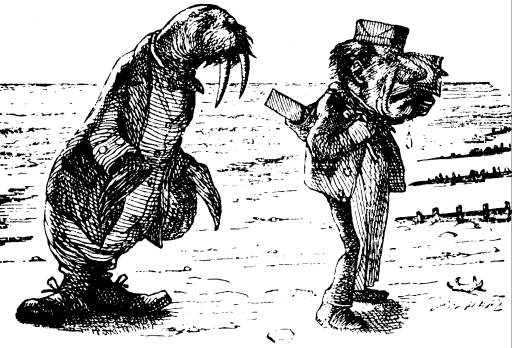
In my youth, I learned a segment of a poem written by Lewis Carroll.  It comes from his most famous work, “Through the Looking Glass and What Alice Found There, published in 1872. That brief snippet of the poem has stayed with me these many decades.  But the poem, in its entirety, seems to offer an analogy to the politics we oysters have chosen for ourselves. 


The Walrus and The Carpenter


The sun was shining on the sea,
Shining with all his might:
He did his very best to make
The billows smooth and bright--
And this was odd, because it was
The middle of the night.

The moon was shining sulkily,
Because she thought the sun
Had got no business to be there
After the day was done--
"It's very rude of him," she said,
"To come and spoil the fun!"

The sea was wet as wet could be,
The sands were dry as dry.
You could not see a cloud, because
No cloud was in the sky:
No birds were flying overhead--
There were no birds to fly.

The Walrus and the Carpenter
Were walking close at hand;
They wept like anything to see
Such quantities of sand:
"If this were only cleared away,"
They said, "it would be grand!"

"If seven maids with seven mops
Swept it for half a year.
Do you suppose," the Walrus said,
"That they could get it clear?"
"I doubt it," said the Carpenter,
And shed a bitter tear.

"O Oysters, come and walk with us!"
The Walrus did beseech.
"A pleasant walk, a pleasant talk,
Along the briny beach:
We cannot do with more than four,
To give a hand to each."

The eldest Oyster looked at him,
But never a word he said:
The eldest Oyster winked his eye,
And shook his heavy head--
Meaning to say he did not choose
To leave the oyster-bed.

But four young Oysters hurried up,
All eager for the treat:
Their coats were brushed, their faces washed,
Their shoes were clean and neat--
And this was odd, because, you know,
They hadn't any feet.

Four other Oysters followed them,
And yet another four;
And thick and fast they came at last,
And more, and more, and more--
All hopping through the frothy waves,
And scrambling to the shore.

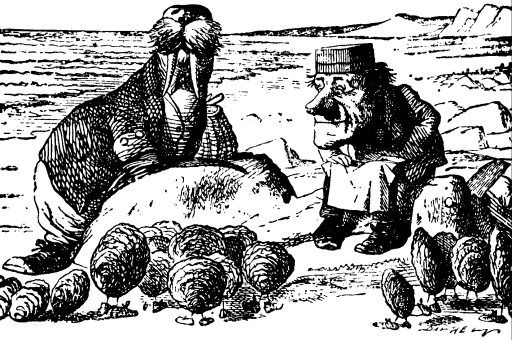
The Walrus and the Carpenter
Walked on a mile or so,
And then they rested on a rock
Conveniently low:
And all the little Oysters stood
And waited in a row.

"The time has come," the Walrus said,
"To talk of many things:
Of shoes--and ships--and sealing-wax--
Of cabbages--and kings--
And why the sea is boiling hot--
And whether pigs have wings."

"But wait a bit," the Oysters cried,
"Before we have our chat;
For some of us are out of breath,
And all of us are fat!"
"No hurry!" said the Carpenter.
They thanked him much for that.

"A loaf of bread," the Walrus said,
"Is what we chiefly need:
Pepper and vinegar besides
Are very good indeed--
Now if you're ready, Oysters dear,
We can begin to feed."

"But not on us!" the Oysters cried,
Turning a little blue.
"After such kindness, that would be
A dismal thing to do!"
"The night is fine," the Walrus said.
"Do you admire the view?

"It was so kind of you to come!
And you are very nice!"
The Carpenter said nothing but
"Cut us another slice:
I wish you were not quite so deaf--
I've had to ask you twice!"

"It seems a shame," the Walrus said,
"To play them such a trick,
After we've brought them out so far,
And made them trot so quick!"
The Carpenter said nothing but
"The butter's spread too thick!"

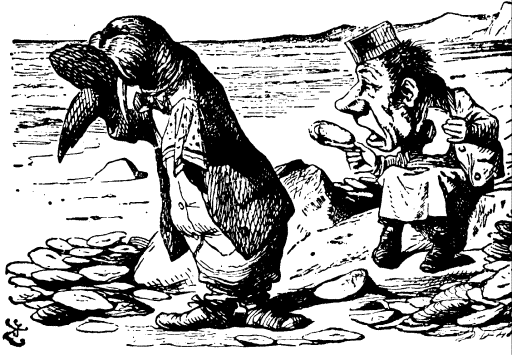
"I weep for you," the Walrus said:
"I deeply sympathize."
With sobs and tears he sorted out
Those of the largest size,
Holding his pocket-handkerchief
Before his streaming eyes.

"O Oysters," said the Carpenter,
"You've had a pleasant run!
Shall we be trotting home again?'
But answer came there none--
And this was scarcely odd, because
They'd eaten every one.

Friday, January 15, 2021

That Was Then - This is Now.

In 2009 I was hopeful the Democratic sweep into the Congress and the White House would result in a functioning government where they would learn from the failures of the Bush/Cheney administration and they would work in a bipartisan manner to solve some of the big problems of America.

I was not against universal health care and would have supported it if they had simply shown how they would pay for it, but they couldn’t.  As it turned out with acknowledgments after the fact there was never any attempt to make it affordable.  It was simply a bait and switch to consolidate government power.

Today, I have no such allusions regarding the transition of power.  The DNC will simply enrich its major stakeholders while making the neediest more dependent on government largess for their survival.  In many ways, it will be a return of the plantation system which is at the heart of the Democratic Party mindset.

Wednesday, December 30, 2020

What Kind of World Do We Want?

At the heart of all our political debates is really one simple question.  What kind of world do we want? What separates us all are not dramatic differences in the answer to this question, but rather our understanding of humanity and the potential to achieve the desired end. Mankind has struggled with this question since the time we began rational thought. Yet, here we are untold millenniums later still wrestling with it.

We’ve gone through how many great and lessor civilizations as we attempt to answer that question for the betterment of us?  But it always comes down to societies where there are those with much and those with little. Why? Today, we see a continuation of the economic struggles we saw in the Nineteenth Century and earlier. The same conditions Charles Dicken’s condemned in his famous depiction of Ebenezer Scrooge. 

Oh! But he was a tight-fisted hand at the grindstone, Scrooge! a squeezing, wrenching, grasping, scraping, clutching, covetous, old sinner! Hard and sharp as flint, from which no steel had ever struck out generous fire; secret, and self-contained, and solitary as an oyster. The cold within him froze his old features, nipped his pointed nose, shrivelled his cheek, stiffened his gait; made his eyes red, his thin lips blue; and spoke out shrewdly in his grating voice. A frosty rime was on his head, and on his eyebrows, and his wiry chin. He carried his own low temperature always about with him; he iced his office in the dog-days; and didn’t thaw it one degree at Christmas.

Why despite all the political protestations and promises of universal wealth have we apparently not progressed onto a utopia where all mankind is rewarded for their being a part of the great society and sharing in the wealth of the planet?

“Socrates defined men as limited and therefore not capable of reaching absolute truth, he also believed they had an immense capability for attaining an ever more refined idea of the just and the good. This awareness and definition of man as primarily a thinking being is the basis of Western philosophy.”[1]

As Socrates noted almost 2,500 years ago, man is limited, and therefore the solutions we enter into are limited by our understandings. Our founding fathers, in their Declaration of Independence from King George and Great Brittan, noted that “all men are created equal” a wonderful statement intended to dismiss the superiority of the Crown.  But does it truly mean that all men and women are equal in all aspects of life?  It wasn’t true when Thomas Jefferson wrote it and it’s not true today.  If it was then everyone would excel at everything and there would be no elites.  It doesn’t matter if it is in sports, entertainment, industry, politics, or finance.  There are elites in each.  Some are born into an elite status; others earn their way into it and still, others join elites only to fall from grace. For example, King George was born into the elite, and because of his inability to govern lost the American Colonies.  O.J. Simpson was perhaps one of the greatest running backs, yet from his choices he has fallen from grace, spending time in prison and carrying with him the accusation of murder. In the 1800s, with the start of the industrial revolution, we saw the rise of wealth with tycoons like Cornelius Vanderbilt (shipping & trains), John D. Rockefeller (oil), Andrew Carnegie (steel) where a few men created employment for thousands, but almost unimaginable wealth for themselves.  

Of course, over time, lesser men and women who did not achieve their own fortunes came to call them the “Robber Barons” of the industrial revolution.  Don’t we see the exact same thing today? Where those who would seek the power and wealth of the billionaires claim billionaires are immoral for their wealth and only achieved it because the government allowed it.  They, the politicians, if given half a chance would seek to redistribute their wealth to make everyone a little richer?  What doesn’t get mentioned too often is what percentage would be taken by those who control the redistribution system, or what would happen to the industries they’ve created?

Mankind has understood since the advent of the written word we come to this life with a variety of qualities.  Some good and some bad.  For the Israelites, God gave Moses 10 rules to live by. Over time they were greatly expanded until Jesus came to simplify them back into their original form. Other faiths and societies have come to similar conclusions. At their heart is the realization mankind is greedy and selfish and allowed to go unchecked it will lead to our destruction. 

Thus, we are in a struggle today, which has been repeated a thousand times throughout history. Is the path to utopia found in an all-powerful government, which makes grand promises, but at the end consolidates its power and wealth in a privileged ruling class, or do we decentralize power to the individuals and expect those individuals to act towards a common good?

Our founders argued this question and we can see the two sides laid out in the Federalist papers and the “anti-Federalist” rebuttal.  In the end, they reached a compromise where they recognized the potential for abuse by the federal system and allowed the states a degree of autonomy as a check for that potential.  They also established a system of “checks and balances” within the federal system.  Unfortunately, over the years the government has grown so vast and powerful there is a real question as to the legitimacy of those checks.

In conclusion, we return to the question of “what kind of world do we want?”  A world where everything is done for us, or one where we have the authority to choose for ourselves what course our life will take?  For those are the two paths we have.  The history of mankind has shown when we have an all-powerful government, the choices of the individual (at least those not in the ruling class) are limited by what the ruling class allows.

Thursday, December 17, 2020

Transitions


The time between the election and the inauguration of the President is one of transition.  Not only for the key political players and their financial backers/ardent supporters but for the common citizen.  It is a time with great similarities to a sporting event where the players on the field move from offense to defense and the spectators’ transition from supporting their team to the condemnation of any event that seems to present a positive gain for the opposition.

We are beginning to see that transition in the media now, where according to the broadcasters the incoming team is above approach.  These are the same “professionals” who just a matter of days ago spent most of their time condemning the current administration as incompetent and incapable of finding their way out a paper bag, despite the evidence that seemed to refute that.  For example, according to the Democratic politicians as broadcast by the media the reason we have over 300,000 dead from COVID is all President Trump’s fault, despite the fact under our system it was the decisions of the various Governors which most affect the death rates within their states.

From a common person perspective, those who have rioted and protested just a few short days and weeks ago claiming America was a fascist blight on the face of the earth are now going to have to claim we are once more a shining light of freedom for that same world.  The irony here is that 99% of the government that were all fascist last week will still be at work after January 20th.

Those politicians in charge of the major cities, who just weeks ago, were justifying the need to defund the police and open their cities to invasion by anarchists are now going to see a need for some limits on what “peaceful” protest really means.  I wonder how the anarchists and the police forces will deal with these political transitions?

On the fashion front, those who thought little of the current first lady’s wardrobe are going now going to be over-the-top in their admiration of the incoming first lady’s fashion sense as she sets the style trends for the nation.  While I doubt she will receive the same adulation as Michele Obama, it seems to me there will be a big demand for extravagant adjectives seeking to reflect how smart she dresses for someone with such brilliant educational credentials.

Speaking of educational credentials, it seems to me to be an amazing thing to have a big kafuffle over.  Some writer says having an Ed. D isn’t the same as being a real doctor and the world goes crazy.  The Ph. Ds and Ed. Ds of the world are united in their belief that having any kind of doctorate is worthy of being called a doctor, while some lawyers with Juris Doctorates seem to disagree.  I’ve not polled the medical community but the few I know are of the opinion they are the only REAL doctors (at least according to Hippocrates). Personally, I know a couple of good ol’ tobacco chewing country boys with Ed. Ds and I think they are good with nicknames, although Dr. REDMAN is probably also acceptable.  I know Whoopi Goldberg weighed in on this at the beginning of the pandemic and claimed Dr. Biden was “a hell of a doctor” so there is that.

But then we can make a dividing controversy out of any and everything.  Take the recently approved COVID immunizations.  Their release this December is a miracle, at least according to the projections of scientists who engage in the political debate. The first doses are going to the frontline workers and those most at risk in the nursing homes.  This seems to be one thing no one is arguing about, but who should get the next release?  Ah, that is worth arguing about.  Should it be the Presidential transition team, the current White House staff, the members of Congress, or those in the public that want to jump on board?  How about those who don’t want the vaccine?  Should they be forced into taking it to use public transportation, or should they have a small yellow COVID star sewn on their clothing so the liberals know who is unclean and not part of this great social movement?

Finally, I wonder if all the entertainment award shows can get back to patting themselves on the back for being so great instead of having to spend the majority of their speaking parts condemning the government.  I know that is probably too much to ask for and now those same celebrities will have to tell us how great it is to be in a nation that supports a unified world solution (except for China and Russia of course) for all the environmental issues the government will now address through its increased taxes.  While we’ve not yet increased taxes I’ll take Biden and Harris at their word that we must do that to rebuild America in their image.

Sunday, December 13, 2020

It's a Curiosity

           It appears the mainstream media has recently noticed that Hunter Biden’s overseas dealings maybe some kind of issue.  This comes on the heels of an announcement the Department of Justice has several on-going investigations into Biden’s financial dealings.  While it would not seem unusual for the press to report these facts it is remarkable, they are just now coming to the forefront.  After the Biden-Harris win.

It is almost as if some hidden power is pulling all the strings in preparation for a transition of the Presidency from Trump to Biden to Harris.  While many of us speculated on the mental soundness of Biden to hold the office it would seem the real kingmakers are leaving nothing to chance.  If they can’t get him out with the 25th Amendment then they go for resignation in lieu of impeachment as the alternative.

My money is on Harris as President before the summer solstice.

Related Posts Plugin for WordPress, Blogger...