Showing posts with label socialism. Show all posts

Saturday, April 23, 2022

What Happens When Reason is Replaced?

What happens when reason is replaced with rage?

At the end of the eighteenth century, both America and France had revolutions to change the status quo.  Both revolutions replaced a monarchy.  In the United States, we severed our union with King George III, of Great Britain. The French chose to redefine the monarchy of King Louis XVI.  Our revolt was spurred, in part, because of dissatisfaction with British taxation, without having a voice in Parliament.  The French were in the middle of failed economic policies by the monarchy, but more importantly, there were famines, droughts, inflation, and taxation of the poor, but not the privileged class.
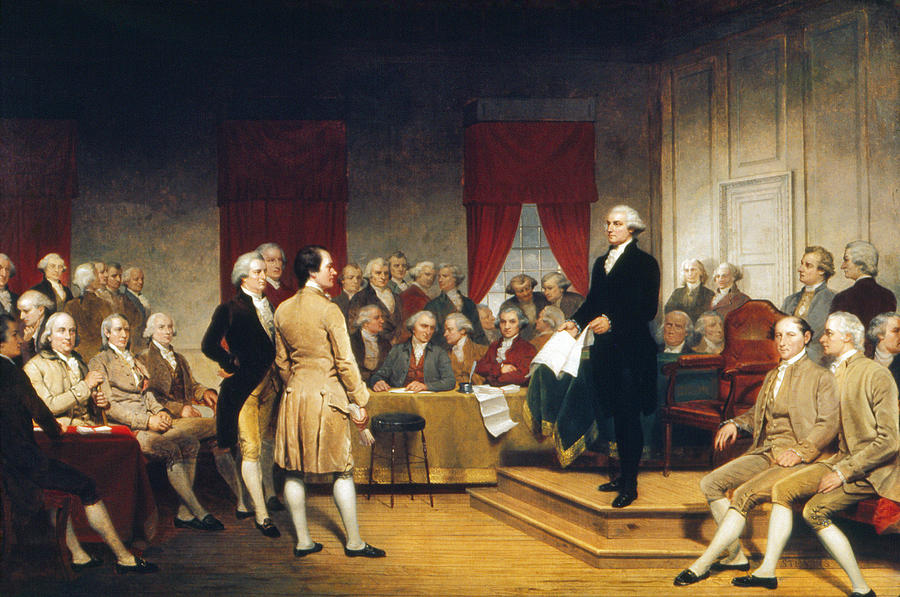

The paths our countries took after the revolution reflect two radically different approaches.  Our revolutions took place at the last stages of the “Age of Enlightenment” or the “Age of Reason” where science became a central idea among the intellectual community and theorists in Philosophy and Political Science began to write on how governments should serve the people, and how all ideas should be questioned and resolved towards a common good.  Our political leaders, schooled in these ideals applied themselves to creating a government to serve the people, provide for general prosperity, and provide for a common defense.  But they knew a government unchecked would eventually grow to be a self-serving institution. To help prevent, or at least slow this process,  they ensured there were a series of rational checks and balances to the power of a single branch.


France, on the other hand, seemed to reject the very concepts of "Reason" we found so inviting.  As the revolution evolved, it moved from reason to madness.  Initially, the revolution sought to limit the authority of the monarchy (roughly similar to what the British had done with the Magna Carta), increase the power of the third estate (the middle class) limit the power of the clergy and the nobility.  But as time went on and discontent with the progress grew there came an insurgent movement by the Jacobins and the peasants against the landowners.  In the end, the revolution and its counter-revolution resulted in the execution of the King, Queen, a lot of nobility, and anyone the revolutionists in power thought deserved to die.  It was the Age of the Guillotine. From the ruin of the revolution, Napoleonian Bonaparte rose to create his first empire.

Why the difference.  Both started with the progressive philosophies of the day, why did one end with an outcome that led to successful self-governance, while the other replaced a King with an Emperor?

Perhaps it is what we see in our urban areas today.  We have the rich, the powerful, and those who depend on the rich and powerful for their survival.  We can speculate as to the cause of this, but are we developing a class of citizens incapable of reason and who seek only their own interests?  While those in power seek to remain in power by responding to the emotional demands of those who cannot see self-interest is, in the end, destructive?

Those who control the power of the state, and their allies who benefit from the largess of those in power, seek to keep the third estate powerless and in chaos so it cannot rise to challenge the power of the first and second.  What better way than to ensure there is sufficient rage amongst those who refuse to see a different path?  But what happens, when there are shortages as there were in France.  When shelves are bare, energy expensive, and working no longer offers hope of a better life.  Will the elite suggest when there is no bread, we should eat cake?

Tuesday, February 16, 2021

The Mindless Accumulation of Wealth.

I was presented with an opinion today as it was a fact. This is not unusual in today’s world, as almost everything we see on television, in social media, and in what is portrayed as news is now opinion, most often presented as fact, but what caught my attention was an opinion on what the phrase “Money can’t buy you happiness.” The author believes the meaning is clearly that the “mindless accumulation of excess wealth leads to diminishing returns on happiness.”  A wonderfully egalitarian view that if you have too much money it won’t improve your happiness (however that is defined).  In fairness, it goes on to say it does not mean “poor people should learn to be content without basic necessities or financial security.” An equally wise and wonderful opinion on what the phase can’t mean. But are either opinion true? 

To answer this question, I think we first should define happiness, but is there such a thing?  Is there one “Universal” standard for happiness? Going back to our founding we see in the Declaration of Independence the claim that all men have an equal claim on the rights of life, liberty, and pursuit of happiness. Did they mean that all men had an equal claim on wealth? The men who wrote these words, and who endorsed them with their signatures had wealth and standing they put at risk with the declaration.  So, it seems unlikely they considered wealth as a key to the pursuit of happiness.  Rather, several scholars note a desire for the government to not control an individual’s life, without that individual having a voice in the decisions.  These three attributes, life, liberty, and the ability to attempt to be happy were, and are, considered natural rights or rights a government can’t (or shouldn’t) attempt to control.

In 1943, Abraham Maslow, a noted American Psychologist, wrote a thesis on what motivates people.  His theory stratified human needs into an escalating series beginning with the most basic of survival needs going up to self-actualization. While the hierarchy deals with human motivation, we can presume it also speaks to the pursuit of happiness, for if you are concerned with where your next meal is coming from, you cannot reasonably pursue your dream, can you?  The socialists among us would say that is absolutely true, yet we have case study after case study where those who ultimately achieved great success did precisely that. How many artists struggle to survive while painting, composing, writing, or in some way creating a masterpiece?  All without the government promising to maintain a standard of living or a minimum livable wage?

At the end of the day I, and others, come away with an understanding that happiness can only be defined by the individual.  What makes me happy is not what will make someone else happy.  The idea of happiness is an intrinsic condition to our species. Is the accumulation of wealth related to happiness? Perhaps for some, but I suspect the accumulation of wealth is a simple by-product of those driven to achieve something that others find ultimately desirable.

For example, is Bill Gates happy?  Let’s assume so.  Would he be happier if he had less wealth, or is he happy because of his wealth?  Or maybe, just maybe there some other reason? How did Gates become wealthy?  He pursued a strategy that made his software the most desired commodity in the dawning of the home computer age. In a time when the world transitioned from analog to digital, he was on the ground floor with a product that allowed that growth. Should the government demand Bill Gates forsake his wealth to pay for others who were not so driven or fortunate, or should Bill be allowed to use his wealth as he sees fit?  That is the question.

Did his pursuit of wealth lead to the loss of happiness for others, or did he bring thousands along with him?  Was his accumulation of extreme wealth mindless or was he driven by some other need?

But what about the “anti-Gates?”  Someone who lives in the inner city, someone who has dropped out of school, someone who can’t hold a job, perhaps is addicted to something, and just barely survives on the welfare of the state?  Is he happy? Should the government do more to improve his lot in life and would that make him happy?  What should the government do?  If happiness is an inner decision then how can the government with all its impersonal decision-making (where one size fits most), motivate this individual to pursue his happiness?

I come back to the basic phrase that started this “Money can’t buy you happiness.” My generation spent the entirety of its parenting years trying to buy happiness with its money.  We created trophies for everyone, we’ve told ourselves and our kids everyone is unique and worth admiration, we’ve tried to minimize the impacts of racism and discrimination while we pursued financial security for our senior years.  Our government told us “don’t worry you have social security,” so too many of us felt we should buy more than we could afford and are now looking at a bleak future.  We’ve passed those qualities on to your youngsters who now believe the government is responsible for making sure everyone achieves all the need levels of Maslow’s hierarchy, while men like Gates, Buffett, Musk, and Bezos are vilified for their extreme wealth and “white privilege.”

When does someone stop and ask, do we have too much government, and are all those supposed safety-net policies destroying the very things the poorest among us need to have the motivation to pursue their own definition of happiness and success? 

Tuesday, June 25, 2019

The Party of Free


The Democratic Party’s Presidential candidates are almost tripping over themselves with promises of free stuff for the people.  This week Bernie has come up with a plan to tax investors (individuals and investment fund managers both large and small) so they can offer “free” education to those who want it, eliminating the problem of student debt.  Of course, Bernie doesn’t frame the tax as something paid by the average person, it will be paid by all those “greedy guys” on Wall Street.

To support him, Rep. Alexandria Ocasio-Cortez has weighed in to show how someone was accepted to her “dream college” but actually had to pay for it herself, and now has about $240,000 in student debt.

These two positions by prominent advocates for socialism raise two questions for me.  The first, why should someone go to college and incur debt with no plan to repay it?  The second, what happens to individual incentive when everything is free?

President Eisenhower, in his Fair Well address to the nation, warned of the Military-Industrial complex we had created with World War II, the Korean War, and the Cold War and how their growing power was influencing government spending.  I think the same could be said for the Education is Mandatory Complex.  The cost of secondary education in the US has far outpaced the inflation rate due to the growth of colleges into mega-institutions of political indoctrination.   

When I graduated from high school, my mother had conditioned me that I would go to college for the better life it offered.  I wanted to be a flyer in the Air Force and to get to that point I needed a college degree, so both Mom and I had mutually supported goals.  At the time I went, there were tens of thousands of young men who were going for other reasons, many young men went to avoid the draft and the likelihood of war in Vietnam, others went to find themselves, still, others just to get away from home.  All were promised a pot of gold at the end of the rainbow.  The colleges offered the opportunity for good jobs and career advancement over peers who had not gone.  That was pretty much a lie then, and it remains so now.  What the right colleges offered was tremendous networking opportunities, and an entryway to further education if you chose.

Fortunately for me, when I went to school the cost of even a private college like I attended was still within the realm of affordability.  I chose a path that got me through and commissioned into the Air Force so I guess you could say I was a success.  But I know several friends who spent four to six years hiding from the draft only to leave and find work as machinists, landscapers, and woodworkers.  Was college really that important to what they wanted for their careers?  By the way, does everyone have a career or do most just have jobs?

Today we have a bloated industry full of self-righteous professionals making six-figure salaries while telling us they are invaluable and we, the rest of the nation, should pay our fair share so they can continue to grow their mega-universities.  Are their arguments all that different than the televangelists who promise God’s salvation if we would just send them a monthly donation of say $50?

Should I feel bad that a girl went to her “dream university” when her parents couldn’t afford it, and her performance didn’t warrant any scholarship offers?  Sorry, I don’t.  The reality: there is a cost to making bad choices, outrageous student debt seems to be one of those costs.

Now let’s talk about what happens to human incentive when everything is free.  First and foremost, who can point out a successful human endeavor that was accomplished without a cost?  Go ahead, I’ll wait.

While I’m waiting I’ll just point out that free housing to the homeless has not solved homelessness.  Free money to the poor has not, for the most part, brought them out of poverty.  Free K-12 education has not eliminated illiteracy.  All the social safety nets we’ve built in this country has not eliminated crime.  Grand (free) mental institutions to house the insane has not made the problems of insanity less problematic.  Oh yes, none of these free things were actually free.  Someone had to pay for them, who was that again?

A story from my childhood education seems relevant here.

There once was a poor immigrant who arrived in America virtually penniless.  He got a job rowing boat in New York City.  He scrimped and saved his meager salary until he could buy his own rowboat to carry people between Manhattan and Staten Island.  It’s a rather long story but it ends with his becoming one of the richest men in the world.  To me, that is the American Dream.  Not the idea that people with money should give it to people who don’t so they can have free stuff.

Tuesday, June 4, 2019

On Government (With Apologies to John Locke)


“What lies behind us and what lies before us are small matters compared to what lies within us. And when we bring what is within us out into the world, miracles happen.”
Henry Stanley Hoskins[1]
“Unless what is within us is petty, selfish and partisan to an extreme”
Me
We are in an age of transition where Americans, free from the demands of daily survival, now seek to rid themselves of the responsibilities of life and place the trust of their own survival on that mythical entity we know as government.  Is this, I wonder, a natural evolution in society as Marx had proposed, or is it an inevitable consequence of the human condition?  A result of our own choices gradually eroding the concepts of independence we felt when the government was a necessary evil to provide a framework for life, but not control it?

But then again, the “American Experience” was a unique experiment in the history of mankind and governments.  Most previous forms of government sought to build power or wealth for those in power and the citizens were capital to be used to support the goals of a few.  It was within this context that Ingle and Marx wrote.  The actual practice of their theories was, at best, flawed by the intemperance of humanity, which has shown up to dominate almost all great endeavors, (regardless of how the those who live with the dream of humanity as an all-caring species would characterize it).

Those who stand to inherit this nation, when the Baby Boomers finally step aside seem to believe the government must provide far more than what our forefathers envisioned.  But then again, haven’t we Baby Boomers and those of the Greatest Generation we come from created the conditions by which those beliefs were institutionalized?

Our parents, the ones who defended western civilization from the Axis powers created the “Great Society,” greatly expanding the safety nets first cast down as part of the “New Deal.”  We, as the young of that age, all agreed that the government must help the poorest of our nation to succeed and rise up from the oppression of poverty.  Unfortunately, like most government efforts, no one is willing to look back and demand answers as to why all those great ideas have done so little to actually accomplish the ideals upon which they were built.  It is far easier to lay the blame at the feet of those who would question the actual results.  It is an easy sell for the idealists to believe everything would be perfect if only those other guys weren’t around.

For the past 75-years, the U.S. dollar has been the currency of choice for the world.  This has afforded us an unimagined opportunity and fiscal stability.  As we continue to place more demands on government than we are willing to pay for, will the dollar remain the international currency of choice?  From my simple views, I think you can see our future in the current state of California.  Once it was ranked as the top in education, transportation, infrastructure, and economic expansion.  Today its infrastructure is crumbling, the cities are degenerating into places of disease and homelessness, home ownership for the middle class is unaffordable, and the government places the rights of non-citizens ahead of its own.  Some of the most dominating technical companies of the world have their headquarters in the state, but from what I can tell they are built behind elaborate security where those who have wealth -- are protected from those who don’t.  I don’t see where all the power and wealth of these companies, led by the young Gen X, Gen Z and Millennials are doing much to spread their corporate wealth to the working class as their socialist leanings would have you believe.  Rather, they call for more government involvement (except where it directly affects their businesses).

So, what will the government look like when, as we will soon see, all our taxes must go to meet the debt payments for the money we’ve borrowed to finance all the great safety nets we’ve created?  I wonder, do people really believe what people like NYC mayor Bill de Blasio said on twitter, “Brothers and sisters, there is plenty of money in this country. There is plenty of money in this world. It’s just in the wrong hands.”  If only we just took all the money the rich people had made and give it to the poor people it would be perfect.  Who better to do this than the government?  Oh yes, the politicians in government need to survive so shouldn’t they get a cut off the top?  Seems to have worked well in the USSR, Cuba, and Venezuela.  Didn’t the government of Finland just dissolve because they could not reach agreement on how to stay solvent while they funded universal healthcare? 
 Fortunately, the world will end in 12 years, won’t it?  Oh, Right!  AOC was just kidding, wasn’t she?

Wednesday, April 3, 2019

But She is Passionate.


Passion is Not the Same as Right
The freshman representative from New York’s 14th district gave an impassioned speech, which fired up her followers.  She passionately explained to a Republican colleague how the New Green Deal is not elitist.  She notes within the first few seconds she just recently got health insurance for the first time in her life and caring about the air one breaths and water one drinks are not elitist concerns.  Her followers are thrilled with how impressive she was in her speech, and she is correct caring about the air and the water you use are not be elitist concerns.  Although caring about the air and water someone else uses seldom rises as primary concerns for politicians, unless of course there is some political capital to be made.
Of course, what gets totally overlooked in this speech are the roles and the failures of government (at all the various levels) in providing the essential things like clean water and breathable air in the district she now represents.  Her position has been clearly stated, a more overarching government, as long as it is the “right” government would fix all the ills of the world. 
Unfortunately, her life experiences seem to be focused on the failures of governments led by individuals who share her political views and without realizing it she lays blame for the bad air and water on individuals who seem more attuned to her political beliefs in a progressive/socialist government, and acquiring personal wealth rather than actually improving the lives of the average citizen in their city.  If you doubt this – just check the record for environmental wellness in NYC since the election of Mayors Bloomberg and de Blasio. Within their terms, while bowing to the will of the social reformers and socialist there has been a marked decline in the simple services like sanitation and improvements to utility infrastructure.  Mayor de Blasio has famously said, “there is more than enough money, it’s just in the wrong hands.”  I believe you find Mayor de Blasio’s wife has done quite well financially as city funds are diverted to her enterprises, while essential social services for the impaired have declined despite the rhetoric.
We can look to Flint, Michigan as a textbook example of the failures of local, state, and the federal government to place the needs of their most dependent citizens first, yet somehow a socialist government would make all this right because somehow under socialism greed and self-interest would magically vanish.  Perhaps I am wrong but hasn’t Flint and Michigan governments been predominately liberal/socialist democratic bastions?  During the eight years of the Obama administration just exactly how much did the EPA and the federal government do to fix the failures of Flint?
Sadly, I’ve not found evidence that her kind of government would actually accomplish all she says it will.  In fact, I’ve seen other impassioned socialists make similar claims about how an all-powerful government would make life wonderful for its citizens.  Universally, those impassioned leaders have failed.  Here are a few specific examples.
Hugo Chavez – elected to lead Venezuela, he promised a socialist wonderland where everyone would have free everything.  He nationalized the oil companies, supposedly using this wealth to enrich the people.  In reality, he created a dictatorship, funneled most of the money to enrich his family, and dragged an oil-rich country into starvation and ruin.
Fidel Castro – overthrowing a politically corrupt government in Cuba, Fidel promised to rise Cuba from the cane fields into a perfect communist state.  Along the way, he nationalized the agriculture of the island while counting heavily on subsistence from the USSR to enrich his family and maintain his domination of politics on the island.  When people became a problem he effectively allowed their escape to the US.  The policies of the Castro government have kept the island-nation locked into the economy of the 1950s, in part because of the sanctions placed by the U.S. as it tried to export its communist principles to other nations in the Western Hemisphere, but to a larger extent his unwillingness to compromise on his global vision for a communist/socialist world where political control remains with a few and the workers receive just enough benefit to continue.   What is most fascinating is the fact the communists of Cuba have been lionized by those who would follow his beliefs that Communism is the wave of the future.  These individuals are most often from the affluent class (where they’ve done little to gain their position) or academia.  It is almost as if they seek a return to the divine right of kings.
Of course, we have those traditional socialist leaders who inspired their nations while actually destroying millions of lives as they pursued the workers ideal.  I speak of course of Joseph Stalin and Mao Zedong. Together they are credited with the killing of anywhere between 7 and 75 million people[1] in an effort to achieve a worker’s paradise.  By the way, this number does not include the deaths resulting from China’s one baby rule.  Both of these socialists were known for their passion, mostly to keep their power, but let’s not quibble with the basis for their passion.
Finally, and I think this is a perfect place to stop, we have that great German socialist.  No, not Marx but Adolph Hitler.  Who better represents the appeal of an impassioned orator’s ability to rise up and instill a sense of power in their followers than Adolph Hitler.  His speeches, first in Munich and then Berlin, crystallized a nation that had suffered at the hands of the French, English, and Americans at the end of the Great War.  The fact is he passionately laid the blame for the depression and inflation that swept the nation at the foot of the German Jews and led his nation into a war that condemned roughly six million Jews to death because of his passionate anti-Semitism, and roughly another ten million from the war he started.


[1] The most popular number for Stalin seems to be 20 million deaths from purges, gulags, and abandonment, while Mao is credited or not credited with the deaths from the cultural revolution which could be as little as 3 million or exceed 45 million.
Related Posts Plugin for WordPress, Blogger...