Showing posts with label Progressive Government. Show all posts

Friday, April 23, 2021

I Care About People (and Other Progressive Lies)

A while back a young progressive-liberal defended her support of BLM with the statement “I care about people.”  Suggesting those who didn’t support the BLM rioting didn’t understand and certainly didn’t care about the lives of the African-American minority.  That thought; “I care about people” has been ruminating around in my brain for a while, and I think my initial thoughts on her statement were actually correct.

Progressives don’t actually care about people; they care about causes.  Caring about people demands personal involvement, caring about causes just requires some sort of positive affirmation of the cause, some outward sign showing you are onboard with the popular movement and therefore a part of the in-crowd.  The latter is far easier than the former, as we see with the corporations who’ve made political statements regarding the changes to the voting laws of Georgia that have absolutely zero effect on the corporations themselves. These public corporations are guided by the major stockholders and the CEO’s all of whom are millionaires or greater, so they really don’t care about the poor or middle class, except as they may affect the corporations' bottom line, and they appear to be betting the woke generation will have the greater impact to their profits than the old-timers.

Let’s review the causes.

Black Lives Matter – a cause that purports to seek equal treatment of African-Americans by law enforcement.  It has chosen as its heroes several felons who’ve died while being taken into custody by police.  It routinely portrays the victims as innocents who suffered at the hands of police brutality.  The narrative is one side has no responsibility for their personal past or actions at the time of the arrest, and the other side is just one example of the systemic racism of America.  To support this narrative the organization has raised millions of dollars and the “trained Marxist” founder Patrisse Khan-Cullors has used that money for what?  As far as I know, she has increased her personal wealth, just like a capitalist[1]. I haven’t seen much work on improving the lives of the African-American community other than rioting.  In fact, a rather famous liberal-progressive, Representative Maxine Waters, has interjected herself into the trial of Raymond Floyd’s alleged killer suggesting if he isn’t convicted the people should take to the streets and riot.[2]  In no case does it seem this cause is at all interested in actually halting the criminal behaviors that lead to these confrontations in the first place, or improving the actual social conditions leading to those criminal behaviors.

A lot of politicians, and progressives are celebrating the conviction of the Minneapolis officer for the death of George Floyd, but as the saying goes; “It ain’t over til the fat lady sings.” Everyone will speculate as to why the jury ruled as they did, but the officer and his lawyer will probably appeal.  What we do know is the rioting will be kept to a minimum by this jury since the mob got the ruling they demanded. Those who support the BLM cause will say justice was served. Those who believe the police officer should have been acquitted will call it a travesty of justice.  Justice, you see, is a value statement and depends on the values of who is reporting it. 

Pro-abortion (AKA Pro-choice) – When the Supreme Court of the United States decided to legislate a new legal standard in the decision Roe vs. Wade the women of America rejoiced.  My generation saw this as a liberating new standard in keeping with the sexual revolution.  Women would no longer be required to carry to term any of the “mistakes” they may have made during their romances or experimentations.  The abuse of children would end as people who didn’t want children wouldn’t be forced to have them.  The financial and social outlooks of young women wouldn’t be damaged by having an unwanted child holding them back.  Today, we have an ongoing and seemingly never-ending fight as those who support the murder of a fetus demand the government pays for the privilege to do so.  You will note the not subtle condemnation of those who support abortion, for we have now almost 50 years of experience and it is obvious to even the most biased observer that abortion has not made the world better.  All the problems that existed before legalized abortion still exist today, in fact, it seems pretty obvious we’ve created a whole new set of issues as many of the problems have gotten far worse as we alter our moral standards regarding personal responsibility and the value of families, the role of responsible parents and education of children.

The SCOTUS said they could not tell when life began, but without a question, medical science has now made a fetus viable almost from conception and yet those who support abortion wish to ignore the reality that life begins inside the womb and not just when they want it to. Those who favor the killing of the unborn have made this a national cause, without regard to the life of the fetus.  It is clear - the only life that matters to them is a post-puberty adult.  With this argument how far away from the time we decide the lives of the handicapped shouldn’t matter either are we?  According to Planned Parenthood, African-American women (who make up 14% of the 14–44-year-old population) accounted for 38% of all abortions in 2018.  We can certainly speculate on the societal effects of destroying these many African-American lives, but this focus certainly supports the idea that abortions are racist, but then the pro-abortion crowd and the BLM groups really don’t support any argument that would weaken their political positions.

A living wage – The cry this past year is to raise the national minimum wage to $15.00, up from the current $7.25.  Just as in every other debate we hear the doom and gloom over how it will only cause prices to rise, or employees to be laid off.  Both of those seem a certainty, and those who are truly unskilled, or handicapped by some disability will suffer if the jobs are automated because they become too costly.  But despite the protestations of the conservatives, the wage will be raised.  It is inevitable.  The ripple effect will be the lowering of the economic well-being of those who make more than the minimum wage as their buying power will be diminished.  The fact that most of the voices demanding this new minimum feel themselves immune from the fiscal realities of increased government mandates do not speak well of their ability to think critically about things like cause & effect and supply & demand.

What I never hear discussed is how the government has altered the industrial basis of our society to create a condition where such a large number of people are unable to progress from an entry-level job, paying a minimum wage, into a more rewarding and productive job paying a viable wage to support the individual and his/her family.  Why is that?

It was, after all, the government who responded to the lobbyist’s push to enter into trade agreements which incentivized businesses to abandon manufacturing in the US and send their products to places like Sri Lanka, Burkina Faso, and of course China to be made by marginalized people or even slave labor. If I recall these discussions correctly the left argued that this was a great way to help those poor unfortunate countries develop into modern societies.  The fact we left those who worked in these industries to deal with the closed factories, and lack of opportunity was just a small price to pay for progress, wasn’t it.  After all, we are the richest nation on earth and so what if we create a greater dependence on the government for our daily needs.  That’s what government is for, isn’t it?

Universal Health Care – Affordable health care is a right and according to the progressive-left, it is an inalienable one at that!  The only problem I see is when the woke generation rejects the idea of a higher power than government how can you say any right is natural or inalienable?  If the rights of the people come from the people and government represents the will of the people then if the government can give and take a right it can’t be inalienable.  While I’m all for universal health care what is the minimum acceptable standard?

The supporters of universal health care believe the current standard of care must be improved, and the problem with our system is the “for-profit” profiteers who enrich themselves at the cost of the masses.  Early in the pandemic, I listened as the woke young progressive liberals lambasted the “for-profit” system for not having enough intensive care facilities to support the expected surge in demand.  As I actually researched this claim, I came to find out there was actually a negligible difference between the administration of “for-profit” hospitals and “not for profit” facilities.  The fiscal reality is that both types have to contain costs if they are to survive.  If we go to a universal care system that obligation to remain affordable simply shifts to the government, and can anyone tell me how the government system will contain costs?  There is nothing that suggests a single person in decision-making authority in the Government gives a damn about constraining cost growth.  There are two fundamental truths in government spending.  If you don’t spend everything you asked for this year you will get less next year, and you are spending other people’s money so when you negotiate a contract be generous.  If you doubt his second truth look at the union contracts teachers in Democratic-controlled states and counties have been able to negotiate.  In Chicago, for example, when the government was actually willing to send students back to school, who had the final say as to whether they would or not?  Was it the parents or the government? No, it was the union.

Now let’s compare the performance of national health care systems like Spain, England, Italy, and Germany in their response to this pandemic?  Did they respond quickly to keep the mortality rates down? Now a year later we can look at the figures and see most of the European countries are running between 1,500 to 1,950 deaths per million of their population.  How does this compare to the United States?  We are at about 1,760 deaths/million so it appears national health care hasn’t made a big difference.  How about in distribution of life-saving vaccines?  Did the national systems develop and field a vaccine quicker?  How about distribution?  Are we seeing the national systems outperform the United States?  All indications are they have not.  Of course, China would appear to be the exception, but who among us believes China is accurately reporting on the disaster they unleashed on the world?

College Debt Forgiveness – Economics majors like Alexandria Ocasio-Cortez and Harvard College Professors like Elizabeth Warren have made a lot of noise about how student debt is weighing down the nation and how much better life would be if we taxpayers just assumed that debt and relieved the individuals from any responsibility for the choices, they made on selecting their options after High School.  This seems to be in keeping with the liberal-progressive view that personal responsibility is a cumbersome carry-over of past generations and the Government should actually be responsible for all the decisions made by its erstwhile voters.  I’ve not paid a lot of attention to how they would actually fund this other than making the billionaires pay “their fair share.” But it is safe to assume the colleges who’ve raised tuition to such astronomical levels to pay their professors half a million dollars a year to teach one course won’t be asked to dip into their endowments to help out.  I’m all for letting everyone have a free Ph.D.  The question that comes immediately to mind is how many PhDs does it take to man the counter at MacBurger Queen?


Monday, June 22, 2020

Building Utopia


A recent exchange with a well-educated young liberal discussed how to end “systemic racism.”  Her ideas all involved having the government do more for the African-American, and in turn (I assume) for everyone.  Below is her list of recommendations.
“The things that have been done to make society "equal" are drops in the bucket. There is a logical fallacy in the idea that just because we don't know exactly what to do, then we shouldn't do anything. What laws should be changed?
We should be transitioning funding into community programs instead of law enforcement. Social workers, free healthcare, better schools, after school programs and training programs, drug abuse programs, mental health resources, affordable housing.
We also need more training and accountability for police. Require licensing, 2-4 years of training, and clear and severe punishments for infractions, including jail time for breaking the law. If police are so scared, they are murdering people, they shouldn't be police. We should absolutely pay police more to compensate for the additional requirements but we need to hold police at a higher standard.
We should have more incentives for businesses to hire underrepresented groups and for colleges/universities to do the same.
We encourage more representation in voting. First, all citizens over the age of 18 should be automatically registered to vote. We should have mail in voting for all elections, and election day should be a national holiday.
We should abolish the electoral college and have rank choice voting (look up Ireland's voting system for an example).
We should get rid of citizens united and limit campaign contributions. All campaign contributions should be public.
We should prohibit anyone in public office from becoming a lobbyist and strictly limit lobbying to politicians.
And to anticipate your next question of how we are going to pay for this? Raise taxes, yes, please, I will be happy to pay more taxes.
We should also eliminate for profit prisons and for-profit hospitals. We should change our sentencing laws to focus to rehabilitation instead of punishment and put more training, mental health, and overall resources into our prison system.
We should give felons the right to vote after they have served their time and make it illegal to ask about felony charges in a job interview except for those directly related to the job position.
Get rid of the death penalty. Improve funding for social workers and public defenders. Many people are in prison because they were pressured to take plea deals because the current criminal system is overburdened. We need a complete over hall.
make marijuana legal on the federal level and provide incentives for small marijuana businesses and marijuana businesses of color.
Limit drug pricing inflation and create a nationalized health care system.”
For our purposes let’s put money aside.  That “how we’re going to pay of it” seems to be a sticking point on both sides, but as we see with the current pandemic, printing money is no object if there is the political will to do so.
What I find in this list is all the progressive talking points from the last few years.  All have some value in creating the utopia the left envisions, but many don’t seem to be grounded in the reality of how our nation is governed and assumes one single/central point for all decisions.  That strikes me as a clear desire to eliminate the federal system we now use and move all decision making to a single capital.  I’m not sure how you get a 2/3rds or greater majority to do that since it would clearly take abandoning or radically changing the current constitution.  The second concern I have is how getting some far-off power to impose its will on the people will actually change the nature of mankind to eliminate racism.
As we look back on our history, that of the United States, we see the great minds have struggled with the question of how do we create a society where all are equal?  The problem with this society of equals is the assumption we are all equally endowed with the same attributes.  I think we can look around today and determine how incredibly false that assumption is.
Looking at sports, since we actually admitted the racist nature of organized sports and began to accept African-Americans into the professional ranks the Black Americans have taken over a dominate role in Basketball, Football, and Baseball (although Hispanics are now replacing many, it is probably from the shift of culture preference more than pure ability).  Is that move based on a demand for racist equality, or a competitive desire to have the best athlete available?  Is the desire to win, a racist notion?
How about Education?  Does everyone perform equally in school and university?  I believe we see the answer is clearly no.  Why is that?  Is it because of systemic racism or is it from some other cause?  Does performance in education require a leveling of opportunity where more people of one race are afforded advantages not afforded to other races based on some arbitrary metric like global origin?  What other social variables might account for why one person performs better than another?  If the latter is true, how does a central government mandate the elimination of those variables? 
Assuming everyone should have the same educational opportunities, regardless of individual ability, at what level does that demand end?  Must everyone complete high school?  College?  Post-college? MS/MA, Ph.D.?  How do we account for those who have less desire but ability, or those with less ability but desire?  If we are to build a Utopian World then who gets to make the decision on what is fair?  Is it the individual, the educational institution, or the Government?
My final thought on this utopian world is captured in my young friend’s statement, “The things that have been done to make society "equal" are drops in the bucket.”  There seems to be one truth in moving towards a utopia.  We can always do something better.  That is a human quality found in all our existence.  We discover fire, but that is not enough we build ovens.  We invent the wheel but let’s hook it up to horses, then steam engines, then automobiles.  We invent a rocket to bomb another country, let’s take it to space, then the moon, and perhaps beyond.  If we were to do all the things, she suggests would we end racism, or would those ideas be simply a “drop in the bucket?”   
How about the rest of the world?  If we made the United States the country, she envisions, without making her plans part of a single world wouldn’t all the evils still exist?  The problem with Utopia is one person’s utopia necessarily becomes another’s Hell until we are all identical in wants, needs, and desires.
This exchange with my young friend only served to reinforce the difference between the progressive approach and the views of our founders.  On the one side, our founders saw too much power in the hands of a single entity ultimately led to the corruption in the purpose of government, while the progressive movement seeks to eliminate personal responsibility from the equation and put the responsibility of moral decisions in the hands of a government (as long as that government does what they want).

Sunday, May 24, 2020

What Happens Next?


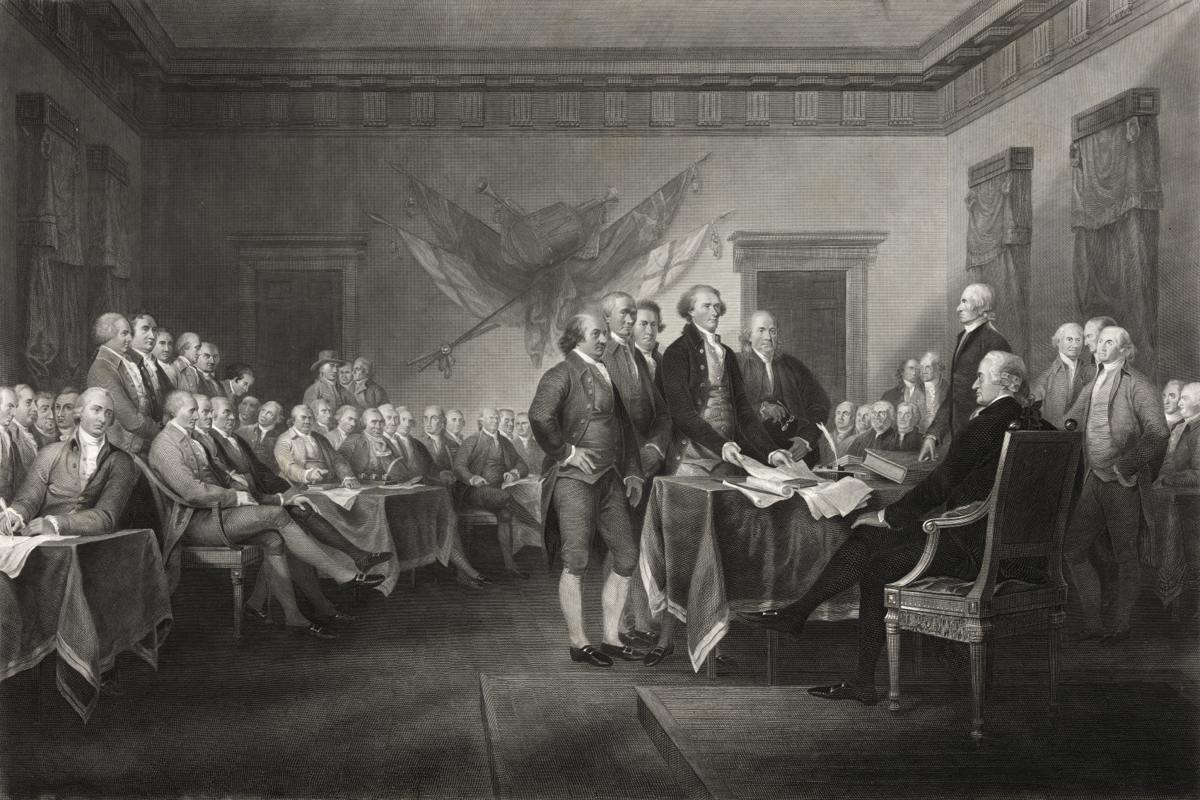
A post this morning (5/24/2020) on social media had me thinking about what happens when the governed lose faith in the government? Our history is built on the very premise the power of government comes not from some absolute right, but from the governed themselves. This was clearly articulated in the second paragraph of our Declaration of Independence

We hold these truths to be self-evident, that all men are created equal, that they are endowed by their Creator with certain unalienable Rights, that among these are Life, Liberty and the pursuit of Happiness.--That to secure these rights, Governments are instituted among Men, deriving their just powers from the consent of the governed, --That whenever any Form of Government becomes destructive of these ends, it is the Right of the People to alter or to abolish it, and to institute new Government, laying its foundation on such principles and organizing its powers in such form, as to them shall seem most likely to effect their Safety and Happiness. Prudence, indeed, will dictate that Governments long established should not be changed for light and transient causes; and accordingly all experience hath shewn, that mankind are more disposed to suffer, while evils are sufferable, than to right themselves by abolishing the forms to which they are accustomed. But when a long train of abuses and usurpations, pursuing invariably the same Object evinces a design to reduce them under absolute Despotism, it is their right, it is their duty, to throw off such Government, and to provide new Guards for their future security.--Such has been the patient sufferance of these Colonies; and such is now the necessity which constrains them to alter their former Systems of Government.[1]

 Our founding fathers did not take lightly the steps they were about to take in their decision to abolish the ties with Great Britain but recognized what they viewed as oppressive taxation without representation in the government itself was untenable.

It seems to me for all their elite education and learning the progressive/liberal left have lost sight of the wisdom of these words. This pandemic is really bringing this into sharp focus, and although President Trump is doing an incredibly poor job explaining it, it seems to me he intuitively understands this and his actions speak to the common man or woman in how they want to live their lives. Trump has all the experts around him and chooses to follow his own path. Meanwhile all the experts and the political opposition are doing everything they can think of to shame him and the nation into doing what they think we should do.

We start with creating the panic, educating the masses on how to act, and then demanding they act by the prescribed solution sets. When education fails to achieve universal compliance our “experts” in science and the media begin a campaign of shaming those who find the burden becoming unreasonable. As our founders recognized we are for the most part willing to suffer through some burdens to maintain the government but at some point, those liabilities become so onerous rebellion becomes inevitable.

We take pride in our elections as a routine form of revolution.  As I think about this ongoing crisis the question for this coming election is not who is the best candidate, or VP candidate.  As much as the media would like that to be the question, the real issue is how much government are we willing to put up with, and who represents that choice of how we want to live our individual lives?  I wonder -- if through their actions, the Democratic governors of the North and Northwest will actually hand the GOP a revolutionary victory?


[1] https://www.archives.gov/founding-docs/declaration-transcript

Friday, February 28, 2020

In a Modern World.


In looking at the great governmental debates going on in the United States I believe they really boil down to two simple (opposing) positions.  Do you believe the government is the answer to most problems or do you believe the government is a source of most problems?  This is a binary question and there are rarely binary problems or solutions, but if you look at the modern political debates everything is painted in absolutes and polarized positions. One side is good, the other evil.

There are clear things we must have a government for and people have organized since before recorded time to address those unavoidable needs.  I’m talking about things like defense, social order, the economy of effort, and other basic needs required for communal wellbeing.

Our founding fathers, as they wrestled with the failures of the government put into place following our divorce from England, argued about what the right kind of government was and how to implement it.  The failures of the Articles of Confederation were obvious in the way it limited the economic well-being and the defense of the colonies.  ThoughtCo provides a good synopsis on the weakness of the original government and the issues the founders hoped to address with their second effort.  In essence, the Confederation failed to provide sufficient centralized power to regulate the commerce between the states and raise a military to defend the colonies from either external threat, or internal rebellion when the need arose.  But in those debates, the fear of an all-powerful centralized government remained fresh in the minds of the political leadership who knew firsthand the potential abuses of the state.

As John Adams wrote,  “It is by balancing each of these powers against the other two, that the efforts in human nature toward tyranny can alone be checked and restrained, and any degree of freedom preserved in the constitution”[1]

I believe, since the Second World War, the government has grown far beyond what the founders could have ever imagined.  For example, Congress was not envisioned as a full-time job.  The capital, built on reclaimed swampland, was uninhabitable in the summer months, so the Representatives would meet for a little while, address the necessary actions and then return to their communities to resume a normal life.  Now they are full-time federal employees responsible more to the people who will offer them wealth than to the people they represent.  Senators were to be responsible to the state governments they represented, now they too are full-time employees seeking the wealth that comes from their positions.  The bureaucracy of the executive branch has never shrunk from what we expanded to in the war, only the roles and responsibilities have changed.  With the social legislation put into place during the Roosevelt years and greatly expanded during Johnson’s administration, we have created layer upon layer of workers and managers whose tenure is untouchable, overseen by the political appointees who will come and go with each new administration.

Ask yourself three questions:

Has this larger more encompassing government made our society better or has it simply reacted to the changing culture by fostering more dependence? 

Do the top-of-the-pyramid politicians shape the course of society or do they simply respond to it, as they vie for political dominance? 

Is the social order actually set by those who are beyond public scrutiny? 

What I find rather humorous, in my own cynical way, is that those who favor an all-powerful government are now emotionally outraged to the point of derangement over the fact their government is led by someone they despise, and he is doing things they don’t like.  It’s almost like they don’t understand Newton’s third law of politics (actually motion but I think you get my point).  To determine if an all-powerful government is really something even worthwhile let’s put that aside and talk about how wisely we, the nation, have chosen to spend our money to make America a kinder, more tolerant, and loving society.

Let’s put defense spending aside for a few minutes, for although that is frequently a topic of how much money the government wastes it is an increasingly smaller share of the total government spending.  Rather, let’s talk about the great social experiment we began with the creation of social security under the Great Depression-era President – Franklin Delano Roosevelt.  The idea behind social security was to create a safety net for those who had been unable to save for their retirement years.  It was planned as a self-paying program where those in the active workforce would pay into the account at rates equal to or higher than people would draw out.

It appears to be a natural condition in humans to believe if the government was going to pay them in retirement they could use the money they should be saving to meet their more immediate desires.  This is the path those in my generation “the baby boomers” chose.  As my generation matured and as the economy flourished the social security account prospered and grew.  Unfortunately for the social planners, the labor force in society has not continued to expand in size at the rates necessary to ensure contributions would always exceed the rates of withdrawal from the account. 

In the 1960s we saw the government add healthcare as an expense that should be borne/shared by the government, as well as the expansion of the social safety nets with increases in the welfare programs.  At the same time, the states began to look into providing their own supplemental programs in healthcare and welfare, and private industry (both healthcare, social welfare, and private insurance) expanded to profit from those new healthcare dollars.  All of these programs became “mandated” or “entitlement” programs and are in fact “must pay” bills the government is obligated to fund before it funds the discretionary things (like defense or infrastructure) that most politicians get rewarded for spending on. 

As the baby boomer generation retires it leaves a much smaller workforce behind to pay into the system that will now payout to the boomers who will live for another 30-40 years.  As a result, the mandatory spending on Social Security and Medicare become an ever-increasing portion of the nation’s gross domestic product.  Growing from roughly 4% in 1970 to 10% in 2016, with projections to grow to 15% shortly and with no relief in sight.  Expenditures are, according to several sources, growing at rates far greater than the general economy.

When you add in the fact that any money laying around on a balance sheet gives the Congress ideas on how to spend it on things like new programs you quickly see a problem where mandated spending will exceed mandated income.  There are always more problems than there are dollars to pay for them, and Congress (whether controlled by Democrats or Republicans) has shown little appetite to limit themselves to the money they will receive in taxes. The solution they always choose is to borrow money based on good faith in the country.  They will borrow until the lenders decide not to lend any more.  For my purposes, I assume the end of the lending train occurs about the same time the dollar stops being the currency of international trade.

The costs aside, what have been the social impacts of an expanding government with an ever-increasing demand for social engineering and social welfare programs?  Are we a better nation for the trillions of dollars we’ve spent on healthcare, social security, and social welfare? 

From my perspective, it sure doesn’t seem like we are.

Remember when the government said everyone should have the right to buy a house, and the government expanded its home-buying guarantees so even people who didn’t have the financial resources necessary to sustain the loans could get them?  We had Fannie Mae and Freddy Mac as pseudo-governmental guarantors of the loans.  Well, those programs certainly worked well, at least until 2008 when all the smoke and mirrors of the programs came crashing down and so many people found themselves in homes they couldn’t afford.  How many lives were impacted by those failures?

How about the basic building block of modern society?  I’m talking about the family unit.  Is the family unit as strong as it once was?  How about in the minority groups like African-Americans, the Hispanics, or the Native Americans?  Have the social support programs we’ve invested in made those groups more independent and stronger, or have they turned them into groups with an increasing dependence on the state?

We talk a lot about the “American Dream” where an individual with the drive and ambition can succeed in life and rise above the station he or she was born into.  Recently Alexandria Ocasio-Cortez said this idea was absurd and no one could raise themselves up without the government doing it for them.  Some found this laughable coming from someone who just a couple of years earlier had been a bartender with a BS in Economics and was now making a six-figure salary as a Congresswoman.  But in one sense she was right.  It took her finding a government job that didn’t require any real skills (other than campaigning) to rise above the challenges she faced with the death of her Father.  Her biography is vague on what her parents did or how she was able to attend Boston University, so maybe she hasn’t pulled herself up at all and her statements are based on her real-life experiences. 

It seems, at least to me, the whole of the Democratic campaign centers on three main points.  First, we have the vehement anti-Trump rhetoric making claims that he is either a tool of the Russians, a bumbling idiot, or a criminal.  Next comes the campaign against wealth with the claims no one needs to be a billionaire and the idea the wealth of the rich takes away from the wealth of the poor (who are poor through no fault of their own), and finally a bigger government (run by the right party) would actually strengthen the middle class.

I’m sorry but after watching a bigger government unfold for the last 50-years, and regardless of the claims by the left’s adored leader, I’m not buying any of their claims.  The record is pretty clear, whenever government becomes the center of all society the middle class is actually weakened, if not destroyed.  It doesn’t matter if there is a Monarch, a Shaw, an Ayatollah, a dictator, a President for Life, a Prime Minister, a Chief, der Führer, or a General Secretary if the average person is totally dependent on the decisions of the Government for their welfare the middle class will be turned into the lower class within a decade.

Monday, July 15, 2019

Amid the Twitter Storm


This weekend President Trump had just a little too much time on his hands and set off yet another twitter® storm of epic proportions.  He suggested in a series of tweets, perhaps those freshman Democrat Representatives who are making such a fuss about the border and the detention centers should go back to their own countries.  Of course, almost everyone with a D behind their names, the media, and all the perpetually offended Hollywood elites were totally outraged.  They flooded social media to clarify, for anyone who had a doubt, how hateful and racist this President is.
But (and that is a longstanding but).
But the question of flight by the intellectual elites from their home countries to Europe and the United States has been a longstanding subject of debate.  They are leaving their countries, seeking a better life for themselves, and leaving behind a country increasingly unable to cope with the issues of modernization precisely because those who could conceivably do something about improving the nation have left.
America has had in place a long-term program to bring eligible young people to the United States to attend our Colleges and Universities, with the expectation they would take that knowledge home, along with warm feelings about the U.S., and help improve the lives of their fellow countrymen.  Of course, some of those on educational visas stayed and became U.S. citizen, but I believe many returned to their homes.  I had a classmate in college who was granted such a visa, he was instrumental in our achieving a national championship in soccer and when college ended he returned home to Uganda with a degree in Chemistry.
Then the Government created immigration policies to allow 65,000 or so skilled workers (and fashion models) to obtain work visas under the H1-B skilled worker program. While this certainly helps the U.S. in some areas (like cheaper labor), doesn’t it do so at a cost to the home nation of the visa holder?   I wonder how good the government has been on ensuring once a visa expires the holder actually returns to his country?  Knowing a thing or two about the government I’m guessing the Departments of State, Labor and Homeland Security have not been all that diligent in holding people to the law.
At the end of the day people are offended when those countries of origin are called $h&t holes, but how will they ever improve if we keep enticing (i.e. stealing) all their brightest citizens?  Here’s an idea, maybe we can offer them a one for one exchange.  We could send 65,000 or so college professors or corporate CEOs back to help them become a first-world nation. 

Monday, June 3, 2019

Returning to a Time Long Gone

It is so nice to see California doing its part to reintroduce life from a simpler (non-digital) time.  For most, we viewed Typhus and Plague as calamities of society relegated to the history books.  We had once believed we knew how to control these diseases and now they've come back thanks to the progressive choices of government leaders.  Well Done!

Bring out your dead! 


Sunday, March 3, 2019

Living in the Real World


Perhaps one of the funniest things I watch these days is the variety of Twitter storms that flash up and are feed by people who’ve come to believe their opinions are totally insightful.  Of course, I approach these festivals of insight with a bias; developed from years of listening to self-important people explain to me all that is wrong with the world, and how if we just do what they suggest it will be great.
For example, as an impressionable young man growing up in the hometown of Franklin Delano Roosevelt I was persuaded by the charism of JFK, and then the social conscience of LBJ as he proposed we greatly expand the welfare state to help those struggling with poverty and no medical insurance.  That plan was going to create a “Great Society” where poverty would be a thing of the past.  Although I didn’t pay too much attention to the details I was sure the creation of Medicare would dramatically improve the health of the nation.  It was only years later that I began to wonder who was paying the bills for it?
Then the self-important created federal enterprises to encourage mortgage companies to write more loans so more poor people could buy houses.  Fannie Mae and Freddy Mac would buy the mortgages from the banks, in theory freeing up bank money to write more loans.  Of course, with the assurance of the Federal Government to back the loans the bankers assumed increasingly less risk and wrote increasingly more risky loans.  Then, in 2008, we had a day of reckoning and all that risk came crashing down.  How many people lost their homes because they had paid far too much for a house, based on an assumption that if they lived in it a couple of years they could turn around and sell it for far more than they paid for it?  It was almost as if we just knew we couldn’t be as foolish and greedy as those poor saps in 1929.
Now we are told the world will end in 12-years, or so, if we don’t get rid of everything that uses fossil fuel.  Again, it seems eerily like the warnings issued a few dozen years ago that unless we immediately got rid of nuclear power we would suffer catastrophic meltdowns what would burn through the earth’s core.
The issue I have with these self-important people making these catastrophic predictions is they seem totally unwilling to lead by example.  It is almost like they are our fathers.  “Do as I say, not as I do!”  Those who seem to have the loudest voices regarding the end of the world also seem to be the ones flying on their own jets, or living in their own multimillion-dollar homes.
Recently, the freshman Representative from New York’s 14th District proposed a radical new approach to saving the world, one that by her reckoning will end in 12 years, where aircraft would be abandoned for highspeed trains and cars powered by hydrocarbon fuels would go the way of the Edsel.  When the NY Post observed she routinely flies from DC back to NYC she posted.  Living in the world as it is isn’t an argument against working towards a better future.  Last time I checked there was a train that ran from NYC to DC and back. 
Apparently, socialists don’t like to be called out for their inconsistencies’.  As one commenter to her tweet noted, “I’ll start listening to your advice when you do.”

Monday, August 6, 2018

Pushing Back on Critical Race Theory


Derrick Bell, a prominent Harvard Law School professor, who later moved to the law school at NYU, together with Alan Freeman of SUNY-Buffalo Law School developed the idea of Critical Race Theory (CRT), as an outgrowth of their work on Critical Law Theory and their disappointment in the slowing of race equality in the 1970s.  The work was widely viewed as ground-breaking within the progressive movement in defining the problems with achieving full equality.  I’ve written in the past on CRT, and the central position that only those in power can be racists while those not in power cannot.  Supporters of CRT translate this to cover the entirety of racial relationships between Caucasians and the rest of the world, seemingly oblivious to the fact Caucasians may not be the race in power in most of the rest of the world.
The problem I see in this theory is the assumption the minority can never be in control or exert their power over a majority.  Even when it proves otherwise, supporters of CRT adhere dogmatically that minorities cannot be racists and only the white majority, attempting to hold the minorities as subservient are the racists.
So here we are in the post-Obama years, when the nation elected a minority President who demonstrated his ability to use the power of the federal government against his opponents and further the goals of his supporters and use race as a club against those who would disagree with his political positions, yet still the left retains the idea that the majority population, by their mere heritage is and will always be racist.
With this assumption, I have to ask – is equality ever possible, or is it really just an illusion in the battle for political domination and the wealth that comes with it?  What I see today are the separate political activists (themselves minorities within the minorities, i.e. LGBTQ, Blacks, Hispanics, Asians) all fighting it out to demand the Caucasian majority submit to their vision of political correctness/control. I suppose I could be wrong in this view, but so far the evidence of how CRT is applied to the political dialogue directly supports it.  If I am wrong it would be nice for someone to show me how I am wrong, but as of right now I assume those who believe I am wrong will reflect I am wrong by asserting I am just another old white racist.  It truly appears to me to be the perfect example of Joseph Heller’s catch-22.
After the 8-years when the Obama administration used all the power of the federal government to attack their political opponents, we have seen a pushback by the usually silent middle class, looking for some sense of normalcy in government.  The average person, more concerned with leading a safe and secure life than changing the entirety of the human condition, has come to mistrust those who have no argument other than everything is the fault of the European-Americans.  Unfortunately, those who make this argument apparently have no recourse but to double down, as if that will prove the validity of their thinking. 
The most recent example is the NY Times hire Sarah Jeong to its editorial board as a specialist in technology.  Ms. Jeong has a long track record on Twitter of railing against the right and wishing that all “old white men” would just die off.  The Times defended its choice saying it had spoken with Ms. Jeong about how best to handle her critics, but clearly, they do not hold Ms. Jeong to the same standards as say a Rosanne Barr.  Clearly, as a Harvard educated woman of Korean heritage she cannot be a racist, so everything is okay.
What this dogmatic commitment to an academic theory is doing seems to be completely contra-productive to a goal of achieving equality and will, I am afraid, only accelerate the movement of rational centralists away from the DNC.  The party will find its power isolated to the rich urban areas where they are sure they are superior to those hicks in the ‘burbs, and as Trump showed in the 2016 election the coastal elites will not gain enough electoral votes to win against him, or whoever succeeds him.  
Of course, the radical left has little concern with this outcome as they riot in the streets, seeking to gain greater government response and hopefully reducing the belief in a government to provide a safe and secure environment for its citizens. 
Perhaps the best thing the Federal government could do is let the major cities deal with this disruption as they see fit, and just stop federal funding for all their services.  Unfortunately, this would create situations envisioned by John Carpenter in such Hollywood blockbusters as “Escape from NY” or “Escape for LA” starring the ever-popular Kurt Russell.  In those films, there was some apocalyptic event.  Maybe the nomination of Ocasio-Cortez as the DNC’s 2024 Presidential candidate will be that event (she will be 35 right?).

Monday, July 9, 2018

Is Space Really the Final Frontier?


The opening line to Star Trek seems a good place to start as we consider our future.  The hopes and humanity depicted by Gene Rodenberry in his 1960s classic, and the franchise that followed is inspiring.  In his model of the Federation he shows the alpha life forms of a whole variety of planets working together for the greater good, but! 
For a story to be interesting it needs to have characters in conflict, for without some form of conflict where is the interest?  Just like the old westerns, there are the good guys, bad guys, and a reason for them to be at odds with each other.  Star Trek followed this classic format just like all great stories.  But life does not usually mirror art, so I have to wonder will we arrive at a point in our humanity where we emulate the grandness of the Federation?  Where we are always the good guys and the distinction between good and evil is simple and clear-cut.
There are those who see a unified earth with a benevolent central government seeking what is best for all humankind.  They are the same people who thought European nationalism led to the conflicts of the great world wars.  At the same time, there are those who look at the darker nature of humankind and see the almost unlimited power such an organization would have as being incredibly dangerous to the rights of an individual.  Those who argue for a strong world government are the same progressive visionaries who set out to create that organization, and thus end what they viewed as a central cause of war, namely the nationalism that led to empire building in the 18th and 19th centuries.  After the first World War and then again after the second they created first with the League of Nations and then with the United Nations, a building block to end the rush to war, but something has gone awry. 
War has not ended, and at least for me, it is still next to impossible to tell the good guys from the bad guys here on our little planet.  The good guys and bad guys are all a matter of perspective.  Didn’t the Klingons view themselves as the good guys, ultimately siding with the Federation as they battled those other bad guys the Romulans?
We see in the liberal-progressive movement the supposedly grand ideas about the better nature of mankind, but also a deep intolerance to anyone who doesn’t buy into those ideas.  (It is almost as if all the liberals suffer from the same human failings as those wayward conservatives.)  At the heart of the approach is how a government is responsible for the making life great for those who can’t make their own lives great.  It is, in a funny kind of way, interesting the historical definition of liberal has been altered to reflect the current intolerance to competing approaches to government.
In all the discussion of bigger government what I never see is an answer on how large it will need to be to overcome the human frailties of intolerance, self-interest, racism, and greed.  Nor do I see any discussion (other than tax the rich) on where the funds for this endeavor will really come from.  By the way, how much did it cost the Federation to create its fleet of starships to defend the empire?  Who actually bore the cost of that endeavor?  In the telling of Star Trek, I don’t think Gene actually laid out the financial structure that made money obsolete, but certainly not all planets were created equal from a natural resource standpoint, were they?  Were all those other “unnamed” members of the Federation expected to ante up the same amount as Earth, after all, we got to be in charge and only a few of them got to serve on the Federation starships?  Obviously, they had their own vessels but you never see them called to save the outposts near the neutral zone, do you? 
In looking at the society we’ve become -- I wonder if we are taking our ideas of society from the fictional stories we’ve grown up watching.  When we take our ideas of social utopia from fiction I wonder how much of human nature we are willing to ignore before it all comes crashing down from the reality of that nature?  After all, Karl Marx saw a worker’s paradise in the form of Communism, but the reality of the Soviet Union presented a far bleaker life for almost everyone not at the top of the political food chain.

Sunday, October 1, 2017

Make it so Number 1

-->
I see California lawmakers are considering a ban on gasoline and diesel-powered vehicles.  I think this is great and they should do it immediately, but to be fair about it they should do it by political party affiliation. 

We know Republicans are: a) the minority party, b) climate change skeptics, and c) anti-progressive.  Therefore, don’t let them have the benefit of all this progress.  Make them drive these gas or diesel vehicles until they change their evil ways.  Maybe as a concession to the more moderate evil-doers allow them hybrids.

Only the progressive left should be allowed the benefit of the energy efficient all-electric cars available today.  They should be allowed to trade in their outdated and polluting vehicles for a cash bonus from all the excess money available within the California budget.

All the celebrities living within major metropolitan areas should convert within 30-days of the Governor signing the bill.  I think Rolls Royce must have a fully electric car by now.  Jay Leno should probably be forced to leave the state and relocate all his old gas and diesel cars.  I am not sure what to do with his Stanley Steamer, but that should probably go as well.

All the current gas stations in the state should be forced to convert to charging stations based on the party affiliation of their owners, or corporate sponsors.  For example, if the CEO of Exxon is a Democrat, all the Exxon stations must convert.  If the CEO of Sammy’s cheap gas is a Republican they won’t be allowed to convert until the CEO does.

Let’s let California bask in the glow of climate and identify politics, and make the world a better place.

Monday, May 1, 2017

Justice - Social and Otherwise


As it seems to be, a Facebook meme got me to thinking. It showed a group of adorable children in a classroom and said something like, “Instead of teaching our children to stand for anthems and pledges, we teach them to stand for social justice.”  I started thinking about what is justice and who gets to decide it?  The easy answer would be – justice is obvious, but is that true?  Especially, in these times where the concept of morality is changing and those advocating for change are so vocal?

What is justice?  Who gets to define it in common use?

It seems to me the concept of justice that evolved from the ancient “eye for an eye” of the old testament, to “equality under the law;” is now evolving again into something where equality is far less important than conformity with some ubiquitous social standard.  As in most things, we will eventually come around to the role of government and control of its resources.

But first a note from our founders: 

Alexander Hamilton, writing in Federalist papers 78-83 laid out his and others views of the necessity of an independent judiciary to resolve conflict between conflicting laws and as a check to the abuses of power by the Executive and the Legislative branches.  His views represent the dominate view of the our judicial system as it has matured over the past 200 years or so.

We often forget there were those who opposed this Constitution of ours, and Brutus writing in the Anti-Federalist papers argued the judiciary should be under the control of those who write the law, for it is their job to meter it out.  Brutus holds an interesting position on the independent judiciary, and it is remarkably similar to those who argue today that the independent judiciary is rewriting the laws to reflect their personal agenda rather than the intent of the law makers.  So, we see his concern played out in our courts today, but that said – who among us would trade the safeguards of an independent judiciary for one that could not check the abuses of either the legislative or executive branches?

Now back to my regularly scheduled opinion:

Although the media will represent the legions of social justice warriors as a dominate voice, in actuality how many of them are there, and is social justice their true purpose, or a useful tool? 

To gain some sort of perspective on a number I will use data from the Department of Education, for FY 2014[i], detailing the total post high school student population in the US.  According to the department it tops out at just over 20 million students.  This includes full time, part time, undergraduate and post graduate students.  While voices of this freedom limiting social-justice movement extend beyond the campus, I believe it is reasonable to assume a significant number of college students are not involved as activists, and may not even provide passive support, but let’s assume they are all supportive, and would roughly equal the number of post college activists.

The question then becomes who forms the leadership that sets the agendas these students advocate for.  The young are not, for the most part, the great thinkers who’ve decided what issues need to be rallied against, or what needs to be quietly swept under the rug.  For this number, let me turn to the Department of Labor and assume all the leadership comes from, or equals the total number of college professors.  The bureau of labor statistics notes in 2014 there were 1,313,000[ii] positions with a growth rate of 13%.  So again, for argument, let’s assume a 10% addition, or roughly 2.0 million additional activists nationwide who are the brains behind the outrage.  Personally, I think this number is high based on normal distribution of leadership within traditional organizations, but as everyone is fond of pointing out this is a “grassroots” movement so there is that.  That brings the total number of active participants in this socially limiting movement to about 25 million, out of a population of 317 million residents in 2014, or roughly 8% of our nation.

With this as a foundation, let’s talk about what the social justice is not and what it is.  It is not about equality and civility.  In, what some would view, as an ideal world we would all be brilliant.  Looks wouldn’t matter, our opinion of our own self-worth would be unaffected by outside influences, we would all respect the roles of our fellow humans, and we would all strive to get along as equals.  Unfortunately, for us the ideal world we live in is far different than the mythical one.  We are not all brilliant, we are more often critical of others as we excuse our own failures, we set artificial definitions of beauty, we look down on those we don’t view as peers, and when possible we seek power and/or wealth.  It seems to me this mantra of “social justice” plays into the baser instincts of those who yell loudest about it.  Is it really about justice, or is it about power and control?  If you can control the language you can control the debate, if you can control the debate you can limit the speech, if you limit the speech you can force conformity.  At the end of the day it is about control, isn’t it?  But control of what?

That is a question for another day.

Saturday, January 28, 2017

CalExit.

From LA Times
The last time Democratic Party controlled states voted to secede from the Union the Republican President and Congress decided to disagree and fight them on the issue.  It was a long and costly effort for both sides, ultimately returning the Confederate states to the union.  Just guessing, I don’t think that would happen again, but of course it would be the start of a domino chain that would effectively end the United States of America as we’ve come to know it.

As in any breakup once the emotional exclamations are over the hard work comes in the division of assets and the accounting of debts and their settlement.  I can’t begin to imagine the nightmare the bean counters will face as they start to close California’s bar tab with the Federal Government.  Then comes the matter of currency.  Fortunately, Chinese investors are buying up so much of California the conversion to the Yuan should be pretty straight forward.

I so look forward to 2018, and the adventures that await.

Thursday, October 20, 2016

Life

Thanks to politics, the media, and the internet, I have been informed that various lives matter.  Fortunately, they have all been color coded so I can keep them straight and root for the right lives when appropriate.  But why do the various colored lives matter?  We have created a society that places little substance, other than rhetoric, on the value of life, so why are we shocked when life is taken from so many before they have reached their full span?

As a society, the progressive movement has succeeded in devaluing any human life that has no voice of its own.  They may be outraged over a dog left chained to a fence in the rain and snow, but challenge them on the right of the unborn and you are waging a war on woman, and of course the organization that finds its origins in the theories of eugenics.  A theory that says we can improve the human race if we promote reproduction of people with the proper traits, and prevent the reproduction of people with the undesirable traits.

We have created sub-cultures where the value of life is so small and insignificant that they pray on the weak and helpless just as our cave dwelling ancestors once did.  We propose to change these cultures through such wonderful ideas as improving education and creating new jobs.  But in the 200 plus years of our history have we actually improved education and created sufficient new jobs to advance these sub-cultures into the greater society, or have we succeeded only in creating an industry of educational experts who are battling a forest fire of social decline with a garden hose.  A hose that is pointed first in one direction, and then another as each new expert claims to have an answer.

As the government grew it created new ideals of what society should be.  We are told it must be inclusive and welcoming to all, but what have we done to the construct of a traditional family, where the Mother and Father are not only committed to their own survival but also to preparing their children for success?  A family where the parents are the primary educators of the young and the schools build on that, rather than the other way around.  I see today’s experts on society placing little value in the traditional family model.  We moved first to the nuclear family, then the blended family, and now the open family.  In each of these shifts the wants of the parents take precedent over the needs of the child.  Is it any wonder the young people of today seem lost and alone when they reach adulthood?

As in most my posts I have far more questions than answers… Life it is all we have until it’s gone.  Perhaps we should value all life, even that of the one we’ve just created?
Related Posts Plugin for WordPress, Blogger...