Showing posts with label flying. Show all posts

Friday, February 2, 2018

Sometimes it's the Simple Things.


One day, sometime in the early 1980’s, a C-130 took off to airdrop some army paratroopers.  It was a pretty straight forward affair until the loadmaster asked if he could leave with the paratroopers?
He explained to the Aircraft Commander he was fully parachute qualified and they had all these parachutes hanging around in the back.  It was just a shame if they never got used.
Remarkably the AC said it was okay.  So off he went.
Keeping the forms accurate presented somewhat of a challenge as well as not having a Loadmaster to monitor engine shutdown.
I think that was the AC’s last flight as an aircraft commander and he soon after found greener pastures with FEDEX.
Sometimes you can only scratch your head and wonder what where they thinking?

Safety - The Legand and The Myth


When I entered the United States Air Force and reached my first operational squadron I was informed we had our monthly wing safety meetings at the Officer’s Mess at 2:30pm on a Friday afternoon, and it was a mandatory formation.  So off I went, along with a classmate from Nav school who had arrived with me.  Once we were all settled in -- the wing safety officer launched into a report of how unsafe we had been over the past month and what changes were being made to make us less unsafe.

Just a couple of weeks earlier we (well maintenance really) had cut the navigation station out of one of our aircraft when they had used a homemade tool on the fuse panel located on the FS 245 bulkhead and severed the LOX line that ran through the bulkhead and around the Nav Station to the co-pilot’s O2 panel.  The heat must have been pretty intense since all the knobs on the overhead panels had melted and now reached all the way to the floor.  The navigator's station had fallen to the ramp, allowing a really unobstructed, if somewhat windy, view for the Navigator.

Once we were all told how to be safe they opened the bar so we could all have a few beers before we drove home (or walked since I was in the BOQ next door).

In the following 42 years I was associated with our service I can’t count the number of safety meetings, or safety investigation board out-briefs I’ve sat through, or the number of material improvement programs I’ve helped define and push for approval or test, but one fact seems inescapable despite all the lessons we have supposedly learned since Lt. Thomas E. Selfridge became the first statistic in the military’s use of powered flight, human error remains at the center of our most serious accidents.  

Fortunately, most of the time we make a mistake it is minor and forgettable, but sometimes we do really stupid things that kill people.  I’ve yet to figure out how we institutionalize universal sound judgment into a profession that demands we occasionally push ourselves and our aircraft to the extreme.  For that reason, safety boards will exist -- as long as manned flight exists and “pilot (or aircrew) error” will continue to be a leading causal factor.

What really bothers me though is how even the simplest material improvements grow to become monumental efforts, or are quietly dismissed by those with the authority to do so without accountability.  Here are two examples.

Image from Politico used under Fair Use restrictions
In 1996, a modified T-43A carrying Commerce Secretary Ron Brown into Croatia crashed when they flew into terrain during an IMC approach.  One of the findings on that accident was the aircraft was not equipped with a flight data recorder as was standard in commercial aviation.  As a result, the DOD issued guidance to equip all passenger carrying aircraft with the black box but did not fund that guidance.  At the time we (AFSOC) were fielding the MC-130H and AC-130U and neither aircraft was equipped with the flight data recorder.  The rationale was if we crashed it was important the enemy not be able to trace our point of origin.  It wasn’t until we started scattering Talon II’s across the landscape that the issue came back up, but in each funding drill the cost to equip two small fleets never made it above the cut line, pushed down by things like laser cannons.

Next, we come to a crashworthy seat for loadmasters in the cargo compartment.  In two crashes early in the global war on terror, we had loadmasters injured or killed because they did not have a suitable seat to secure themselves to.  So, the SIB recommended we develop one.  How much and how long do you think that should take?  It took over $10M and 10-years and I’m not sure we have all that great a solution today.  I would defer to those flying on the HC or MC-130J to how well it works.  I doubt that AMC or AMC gained units have bought them for their aircraft, but then I’m no longer in the loop on that.

Safety is kind of like a unicorn… or maybe the pot of gold at the end of the rainbow.  We know it is important, but how do you find it, and what do you do with it once you have?

Wednesday, January 24, 2018

So Tell Me Captain - Other Than That How Was the Flight?


            No CSO’s were harmed in the telling of this story.

Fairly early in this Global War on Terror, AFSOC expanded its airlift fleet with what was referred to as non-standard aviation.  Small commercial aircraft intended to move special operations forces to their destinations without much fanfare and at costs far below that of using a C-130 to carry the half dozen to a dozen people on a SEAL team or A-Team.

While USSOCOM was busy buying the Dornier 328’s used today, AFSOC leased a few interim aircraft (I think they were DeHavilland Dash 8s) to jump-start the program.  We built up the crew force from a number of sources, primarily from AMC.

Two of the aircraft were deployed to Africa to support the newly created AFRICOM, whose headquarters is in Stuttgart.  Periodically one of the aircraft would make the journey from their forward operating location to the HQ to coordinate and shuttle personnel and material back from Germany.

On the way back from one such trip the aircraft needed to stop for gas.  If I recall correctly it was somewhere around Sierra Leone or the Ivory Coast.  They had some problems with the local officials and the AC made the decision to press on without the gas.

When they got to altitude the flight management system showed they did not have the fuel necessary to make it home.  They started a gradual descent and the FMS said they could make it, then they leveled off and it said they wouldn’t. They played this game a number of times, always ending up where their fuel flows were worse than when they started due to the lower density altitude.

Rather than look for an alternate (they are few and far between in Africa) they pressed on until it was clear they could not make it, declared an emergency, and began to divert to an alternate (that was actually just as far away as home).  I think they skidded to a power out halt about ten miles from the runway they were trying to reach, and 12 hours from a rescue team.

The AC was a former KC-135 pilot and the co-pilot was (I think) much less experienced.  If I recall correctly both had less than a hundred hours in type.  There are two lessons I think should come from this cautionary tale.

Don’t let hubris cloud your judgment.  Admit mistakes early, review options quickly, and commit to a best course of action, even if you think someone will yell at you.

Know how your FMS works and keep in mind reducing altitude is unlikely to extend your range unless you are near your service ceiling, or can start a reduced power descent all the way to the runway.

BTW, the 12 cases of German beer stowed onboard all survived the crash… so at least we have that...

Tuesday, January 23, 2018

How Far Can a U-28 Glide?


-->
One day, long ago, as AFSOC’s U-28 program was getting underway the initial cadre were developing the tactics, techniques, and procedures needed to bring game-changing ISR to the ground forces and theater commanders.
As part of that build up, and given the fact it was a single engine aircraft the flight crews began working on flameout procedures for the aircraft.  Although the procedures were in the manuals, some felt it was much better to keep the aircraft in a clean configuration until just prior to landing, and at the last moment drop the gear and flaps.  This way their glide ratio would be optimized and they would cover a greater distance.
Unfortunately, they failed to consider the negatives of crew workload, changes in learned behavior and stress.  When they were practicing this technique one day someone forgot to put the gear down at that “last moment” and they came to a rather abrupt stop shortly after the flare.
My take away was… it can glide all the way to a full stop.  The nature of that stop depends on the aircrew's situational awareness.

Wednesday, January 17, 2018

One Step Forward, Two Steps (not forward)


This post is a recollection of a couple of stories from an IP I flew with once upon a time.

I was told he had gotten a C-47 out of UPT.  It was an aircraft whose speed ideally suited his thought processes.  It always seemed to me he was just a touch behind the aircraft at the blazing speeds found in a C-130.

Taxiing at NAS Cubi Point

One day we made a wrong turn down a taxiway that had no outlet.  We went about a hundred or so yards down it before tower called and asked us where we thought we were going.  We had a co-pilot in the left seat on his very first AC upgrade ride and Milton (not his real name), in the right seat providing the instruction. 

The taxiway was not wide enough to turn around so we would have to back up about 100 or so yards until we could turn and get onto the right taxiway.  This is ordinarily not too big a deal as long as it’s not too hot and the engines don’t overheat.  We would lower the ramp, and the pilots would follow the directions of the loadmaster who was scanning behind us.  There was one cardinal rule “DON’T TOUCH THE BRAKES.”  Speed was controlled by using the engines and the prop pitch. 

We started to back up with the loadmaster doing a great job of telling us how far we had to go, and when to begin slowing down.  Unfortunately, Milton was busy telling the co-pilot all the things he should be doing, like listening to the LM, that he wasn’t paying attention to the spiel about “straight back, 50-yards, begin slowing down, slow down, we need to slow down, we need to STOP.”  It was that last word that finally broke through and got his attention.  At that time both pilots stepped on the brakes.

I was standing behind the IP (in the right seat), and as we came to a stop the nose of the aircraft rose up until the ramp hit the ground and stopped further travel.  All the sudden I was in the air and the roof of the cockpit smashed me on the head as we came crashing back down.

We limped into parking, noted there might be a small problem with the nose gear and headed off to the club for lunch.  I think it took a couple of days to fix that problem of a compressed nose gear and how it attached to the rest of the airplane.

Air Intercepts over Korea

Our electronic warfare officers had a semi-annual requirement to train against air-to-air threats.  Usually, this was a simple sortie where a couple of F-4s from Kadena would come out and intercept us. Occasionally, we could get some good training at Cope Thunder or head up to Korea to play with them.  There were, I recall, three levels of threat maneuvering we could do, depending on the adversary and what we had briefed.  Level 1 was pretty benign, level 2 more aggressive, and level 3 allowed us to maneuver pretty aggressively (aggressively being a relative term in a C-130).

  Any who, we were sent up to Korea to be a target for some unidentified fighters.  It was a crappy day on the surface but beautifully clear above 10,000 feet, so that was where we went.  A big black and green aircraft about 4,000 feet above a solid white cloud deck.  We were cleared for level three maneuvers allowing 45-60-degree banking, a couple of thousand feet in altitude change, and use of our chaff and flares.

We droned around for a short while, when all the sudden our EWO called a threat break to the right.  We rolled smoothly into 10-degrees of right bank while Milton explained to the co-pilot how important situational awareness was.  The EWO called a break to the left and we rolled smoothly into a 10-degree left bank.  I think this was about that time the pitch on the EWO’s break calls went up just like the RWR gear.

I was looking out the right windows for the threat when I saw an F-15 come screaming down at us.  I heard “Fox 1, Fox 2, Fox 3, off target.”  Then his wingman called out “Fox 1, Fox 2, Fox 3.”

The AC’s comment was along the lines of “That went well, if we hurry we can still make lunch at the Osan O-club.”  I don’t think the EWO was especially happy.

Saturday, December 23, 2017

Flying is Unforgiving


I learned very long ago that flight is demanding.  It does not forgive mistakes easily, nor does it tolerate poor judgement for long.  The same can be said of life, but there is a little more room for error when walking down the street than there is when traveling in a 70-ton cylinder at speeds that cover multiple miles in a minute.  I would like to share a story of one accident that took the lives of my friends, but remarkably spared one.
It happened in the early morning hours of February 26, 1981.  The place was the ocean waters near NAS Cubi Point, Philippines.
The aircrew were assigned to the 1st Special Operations Squadron.  The unit had recently moved from Kadena AB, Japan to Clark AB, Philippines.  They were participating in a demanding Special Operations Exercise with US Navy SEALS and Australian SAS.   For the year prior to the accident the unit had been heavily tasked as it trained for the rescue of Americans from Iran, while also going through a short notice unit relocation.
The crew involved in the accident were all experienced, although one of the navigators had just arrived at the unit, and was getting his theater checkout from the units Evaluator Nav.
The aircraft was a highly modified MC-130E, equipped with a dual mode terrain following/mapping radar, as well as IR lights for use during landing when using night vision goggles (NVGs).  The use of NVGs was something we had developed for the Iranian mission and had become a standard tactic for the unit.  Unfortunately, the standard night lighting in the cockpit washed out the NVGs and as a workaround technique the aircrew had taken to covering offending lights with duct tape with small slits for the important things like the fire warning system.  This “ad hoc” technique, although not standard, was approved for operational use.
The night’s mission was to infiltrate into an island landing zone, extract the special operations teams and return to Naval Air Station Cubi Point.  The low-level and night assault were the most demanding phases of the mission.  The exfil was thought of as being more administrative, although they would remain low-level until reaching the initial approach fix for Cubi.
The APQ-122 (v8) radar was a good system, but it did have a couple of known issues when operating over open waters with a calm sea-state.  Without good radar returns the system would begin a descent (assuming it was above the set clearance).  To keep from descending too low the radar altimeter was set to 80% of set clearance and was supposed to hold the glide path commands level until the radar had sufficient returns to resume guidance.  That feature was known as “altimeter override.” If you reached 80% set clearance the low altitude warning light would come on to alert the crew.  Unfortunately, the technique of taping the warning light would prove a dangerous and perhaps fatal technique.
The accident report indicated the aircrew flew a shallow, power-on, descent into the water not far from the Philippine coast.  On impact the aircraft broke up (I think at FS-245) and 8 of the 9 crew and the 15 passengers were killed.  Those familiar with a C-130 will recognize FS-245 is the point where the nose is joined to the fuselage of the aircraft during manufacture and is a structural separation point. 
The lone survivor was a young electronic warfare office who had his head down on the console and slammed head first into the EW equipment before being thrown out through the opening created when the aircraft came apart and sank.  His station was just aft of -245.  He was recovered by local fisherman in a partially inflated life raft that also was ejected as the aircraft sank.  The radio operator, right next to him was sitting upright in his seat, his neck was broken by the deceleration forces.
The IN and FE that evening were my good friends and crewmates on the Desert One mission we had flown almost exactly 10-months earlier.
Fatigue was cited as a causal factor along with the technique of covering important warning lights.  The hard lessons of accidents should be remembered, but too often they are put on the shelf unless captured in a WARNING or boldface.
If I could offer one piece of advice for someone coming into a new weapon system it would be to find the safety officer and try and read as many accident reports on your aircraft as you can find.  Since most accidents have crew error as a causal or contributing factor it would seem useful to understand how others have screwed up.  We don’t do that and unfortunately, I have seen avoidable mistakes repeated because in time even the “old heads” just don’t know.
Just food for thought.

Saturday, June 24, 2017

Into the Night


As the sun sets in the west, the heat still boils off the land.  The crews walk to their aircraft, each quietly considering the tasks before them.
This scene has been played out ten thousand times, in a thousand different locations.  In every case, there was a mixture of excitement, confidence, dread, and hope.
Quietly, but with anticipation, they strap themselves into their seats, becoming one with their aircraft.  If the aircraft is the body, the skeleton, sinew and flesh, its hydraulic system its lifeblood, its engines the heart that makes it all go, then they are the mind and the soul of this entity, and they will feel the joy or pain of the flight.
As the engines come to life, as the systems warm and ready, the crews finish their final preparations.  Soon, they will hurl themselves into the night seeking the darkness as a cloak.  There they will hide until the first light of morning finds them returning to their perch.

Tuesday, October 18, 2016

Flight

From time immemorial the idea that man should fly has been with us.  Unfortunately, the earliest technology did not make for long and sustained flight.  The attempts lasted only long enough to reach the site of the crash.  From Daedalus, and his son Icarus, through Leonardo DiVinci, past the Montgolfiers, past Lilienthal and Langley, until we find two brothers name Wright the ability for controlled flight escaped mankind.
What Orville and Wilbur discovered was it took three things for flight.  The first was the ability to control the craft on the three axis we call pitch (up and down from centerline), roll (rotation around the centerline), and yaw (angular movement left and right of centerline), the second was an engine powerful enough to propel the craft with sufficient speed to overcome the force of gravity, and the third and most important was the skill to manage the first two. 
They learned pretty quickly after those first flights at Kitty Hawk that flying was not as simple as stepping into the craft, starting it up, and taking off.  It took discipline, understanding and practice.  And as with most things in the human experience time has taught us some are better at flying than others.
In the course of sixty or so years man went from the efforts of Orville and Wilbur to get a few feet off the earth, to settling a craft on the moon.  We went from walking speeds to escape velocity.  We built aircraft with increasing complexity and size such that we could carry the entire Wright Family, along with their flyer, across the ocean in a few hours if we chose.
In the following fifty years we have refined some things, but flight has become so common place it no longer holds our collective fascination as it once did.  That is a shame, for there is much we have missed.

Thursday, October 1, 2015

Not All Good Ideas are Great!

It was a warm spring day here in Northwest Florida.  That day, like most of my days, involved talking with various agencies, reading draft test plans and reports, and doing all the “administriva” necessary to keep a flying test squadron running smoothly.  The sun was shining, the winds were light, and I had ridden my bike the five miles to work.  In the morning briefs my test teams laid out their plans for the day.  There was nothing exceptional and no reason for me to question the teams on the exact details of any of the events.  In fact, we were hosting some Army Aviation personnel who were conducting some tests with the Navy’s Special Boat Squadron and their development folks down in Panama City.  It was not our test, and we had no oversight.  We were there to help coordinate test range issues, base operating issues and otherwise provide administrative support to the Army.

At about 11 am I broke for lunch and went for a bike ride.  I arrived back in the squadron around 12:30 and was met by the team helping coordinate the Army test.  I suspected things would get interesting when they greeted me with “Sir, we need to talk!”  We headed into my office and closed the door.


Tech Sergeant Smith began.  “Sir, we’ve just received reports that the Army and Navy test that was going on today had an accident.” I stop him at this point to ask if there were any injuries or fatalities.  Thankfully the answer was no.  There was some damage to the MH-47, and the sub they were transporting had been dropped into the Gulf.  Sergeant Smith goes on.  “Recovery operations are underway for the sub and the MH-47 has recovered to Hurlburt and their agency leadership has been notified.  We’ve notified our higher headquarters and all necessary reporting has been done.”  At this point I interrupt and realize that since I’d not reviewed the Army’s test plan I didn’t really know what they were doing today so I ask Sergeant Smith to bring me up to speed.

“Well Sir, the plan was to launch from here, fly down to Panama City, meet up with the Navy and do some sling load testing of the new swimmer delivery vehicle they had developed.  Everything was going according to plan until they were out over the Gulf and had the mini-sub slung under the -47.  When the helo began a turn the sub started to put slack into the line and was turning inside the helicopter.  The guy monitoring the line didn’t react quickly enough and the sub hit the helicopter just about the time the helicopter jettisoned the sling.  The sub then fell into the Gulf and we think it’s in about 200’ of water.  They are out looking for it right now.”

Lessons learned:  Subs can fly, perhaps better than helicopters.  If you don’t think something is possible, you’ve probably not thought through all the possibilities.


Post script:  No one was hurt, they found and recovered the swimmer delivery vehicle,  and at least two pilots have the ability to tell people about their mid-air collision with a submarine and how it wasn’t their fault.

Monday, February 23, 2015

Trails in the Sky


It was a summer’s day, warm and just a bit muggy.  We were playing in the fields behind the house in the Holt Development of Hyde Park.  I don’t recall exactly what we were playing, but Cowboys and Indians is a safe bet.  Of course in today’s world if we were playing Cowboys and Indians half of us would have to be dressed in Langoti.  But I digress.
Anyway, we were running, shooting our cap guns, hiding, running and shooting all over the place.  I don’t think anyone was actually killed, and I don’t even think the neighbors, if they were aware of this massive on-going conflict, actually called the police to come arrest us for unnecessary gunplay and violence.  We just continued to wage war on each other, changing sides and fortunes as the need arose.
But it was during one of these epic battles that I happened to look to the sky and see an Air Force transport pass overhead.  Soon another flew by, and then a third.  I stopped, in awe of the aircraft, and the trails they were laying out behind them. Today, I know they were C-123 Providers, and they were probably spraying pesticide for mosquitos.  It was probably not the best of places to be, but fortunately I don’t think I have come through that encounter any the worse for the experience, just the opposite.
That was my awakening to a world that would someday become my home.  To look down on the land from the flight deck of a cargo aircraft and see it pass as we flew low over the ground to bring relief supplies to those in need, or to infiltrate behind the enemy lines to drop off Special Forces, or just fly to practice flying.  We had an expression in those halcyon days of my early career.  “If God had wanted man to fly he would have been born with green baggy skin” like the flight suits we wore.
It is now almost sixty years since I looked up.  A lifetime has come and gone, and I will be forever grateful to those airmen who laid out the trails for me to follow.  They helped shape a world where time and space shrank, where frontiers reached the heavens, and technology took man to the moon.
I can only hope that in some small way I marked a trail for others.

Friday, March 9, 2012

Skimming the Cloud Tops


There are few times in your life when things are crystal clear, and you know exactly why you are here, and what you are meant to do.  In between those times it is very easy to get caught up in the mundane aspects of life, work, family, weekends, or self-importance.  These are the times when we find ourselves involved in things like the petty fights between siblings, or the bickering of two people talking politics, name calling and other childish, but unchild-like behavior.
For me, the rush of speed as you burst through the tops of the clouds and you rush along the canyons of air, or as you twist and turn at treetop level focusing your entire being on the moment directly before you.  It is too bad we can’t find in our daily lives a way to channel the important efforts before us into that same concentration.  To be in the moment, 100% committed to our decision and the actions that follow from it.  If we could, I think the petty annoyances would fall like beads of rain rushing off the widow we are looking through.

Sunday, January 29, 2012

Humans are Competitive

We will make a competition out of almost anything.

Friday, September 2, 2011

Stop Me If You've Heard This Before.


Frankfurt International Airport is notorious for having arrogant controllers who expect their commands to be carried out swiftly and with precision.  One day there was an exchange that went something like this.
Tower Controller:  Speedbird 435 continue to taxiway Charlie and exit right, hold short of parallel taxiway until cleared.
Speedbird (the call sign for British Airways) 435:  Roger.
As Speedbird 435 exits the runway at taxiway Charlie he fails to stop short of the parallel taxiway, turning onto it.  The tower immediately calls him up.
Tower controller:  Speedbird 435 you have violated my instructions, have you never been to this airport before?
Speedbird 435:  Sorry Frankfurt, yes I’ve been here before, in 1944, it was dark, and I was flying a Lancaster at 25,000 feet.
Frankfurt Tower:  a pause, ah… Speedbird continue to your gate.
______________________
Flying precision radar approaches into foreign countries can be a challenge for American aircrews unfamiliar with the inflection of someone who is speaking English as a second language.  This is an approach I was on with a C-130 crew from Dyess AFB, TX.  I will try and show the inflection with the added a’s.
Pisa Arrival:  Old(a) 45 you are cleareda to descenda to 3,000 feet for hand offa to approach control.
Old 45:  Pisa approach, Old 45 level at 3,000 feet for precision radar to runway 04 right.
Pisa Approach:  Olda 45 we have you, you are cleared for approach you willa begin youra descent in three miles.  Maintain heading, maintain altitude, do nota acknowledge furthra transmissions, Okay?
Old 45, Roger.
Pisa Approach:  Olda 45 begina descent nowa, come right o43a degrees, 7 miles froma touch down
Pisa:  Olda 45, continue descent, on glida patha, heading 043, 6 miles froma touch down
Pisa:  Olda 45, slowa ur descent, slightly below glida patha, heading now 045 degrees, 5 miles from touch down
Pisa:  Olda 45, you below glida path now, slowa descent, heading left 040 degrees, 4 miles from touchdown
Pisa: Olda 45, You well below glida slope, I tella you to slowa descent, you no listen you busta you ass.
Pisa:  Olda 45, You com’n back to glide slow now, heading 040 touchdown in 2 miles.

Wednesday, December 1, 2010

Things I Miss

As the winter approaches this is a good time to reflect on the past and perhaps share some recollections.  This will be a short summary of the things I've experienced and miss because I may never see them again.


I miss German Drivers -- I live in Florida where half the drivers can't look over the steering wheel.  In Florida you don't really have to actually drive on a public road to get  your license.  I know because I had two kids go through drivers ed and they got there licenses without a road test.  The only time they were on the road was when I took them.  Here in Florida, half the people never use turn indicators, and the other half never turn them off so it all kind of evens out.  Living in Germany everyone seemed to know what they were doing, even at 200 km/h.  For example, the only time you were in the left lane of the autobahn was to pass, or if you owned a Mercedes Benz doing 250 km/h.  On top of that they could read all those funny traffic signs.

I know this is Italian, but it is cool
In large groups they were pushy, but on the road I can't think of anyone else I would rather have driving near me.  They were predicable and dependable.  I always knew what they would be doing.  Of course when something did go wrong it went really-really wrong and 200 car pile ups were not unknown.

I miss Norway -- Outside the good ol' USA I think Norway is the place I would like to live.  The countryside is beautiful, the people are friendly, and everyone speaks English.  The only bad part of the country is beer is pretty expensive.  They have this drink called aquavit that is supposedly put in the hold of a ship and sailed around the world to age.  I found it is a wonderful drink on a cold Norwegian winters night, but like vodka it can sneak up on you.  In the summer it is great to sit on a roof top bar and watch the sun not set.

I would like to say I miss Warsaw Poland, I understand it is a beautiful city, but in 1976 when I was there the Iron Curtain was still up and the city was the most depressing place I have ever been.  There were still bullet holes in most of the buildings from WWII and signs up everywhere showing where polish patriots had been killed by the Nazi's.  We were followed around by the Secret Police (who weren't very secretive about it) and no one who saw us would smile or acknowledge our presence.  So unfortunately I don't miss Warsaw.

I miss flying low level 250 feet above the ground on a pitch black night, running down valley's, crossing ridge lines, and generally feeling invincible because you are somewhere no one else  but you and the rest of the crew can be.  I miss planning the complex missions that actually make a difference in someones life.  The MC-130E was the first plane into Iran in 1980, the first plane over Granada in 1983, the first plane over Panama in 1989 and dropped the biggest bombs in Operation Desert Storm in 1991.

I miss Singapore, probably the cleanest large city I have ever seen.  I could understand why they caned Michael Fay for vandalism.  A population of 4 million people who all pick up after themselves.  Although I think they go way overboard with concrete.  They had a small park donated to the city by the inventor of "Tiger Balm."  Whoever made all the statues in Tiger Balm Gardens must have had some serious nightmares as a youth.

I miss Americans who can write complete sentences.  Everyday I see college graduates struggle to put complete thoughts into the written word.  OMG w/i 10 yrs ths wil b cmplt sent.

I miss English Pubs.  Generally the food in real restaurants in England had a lot of room for improvement, but "pub snacks" like fish and chips were absolutely wonderful.  A glass of ale and a pub snack goes a long way to explaining why the English are such a great people.  Lousy teeth, but great people.  I especially like their sense of humor.  Live on Monty Python!

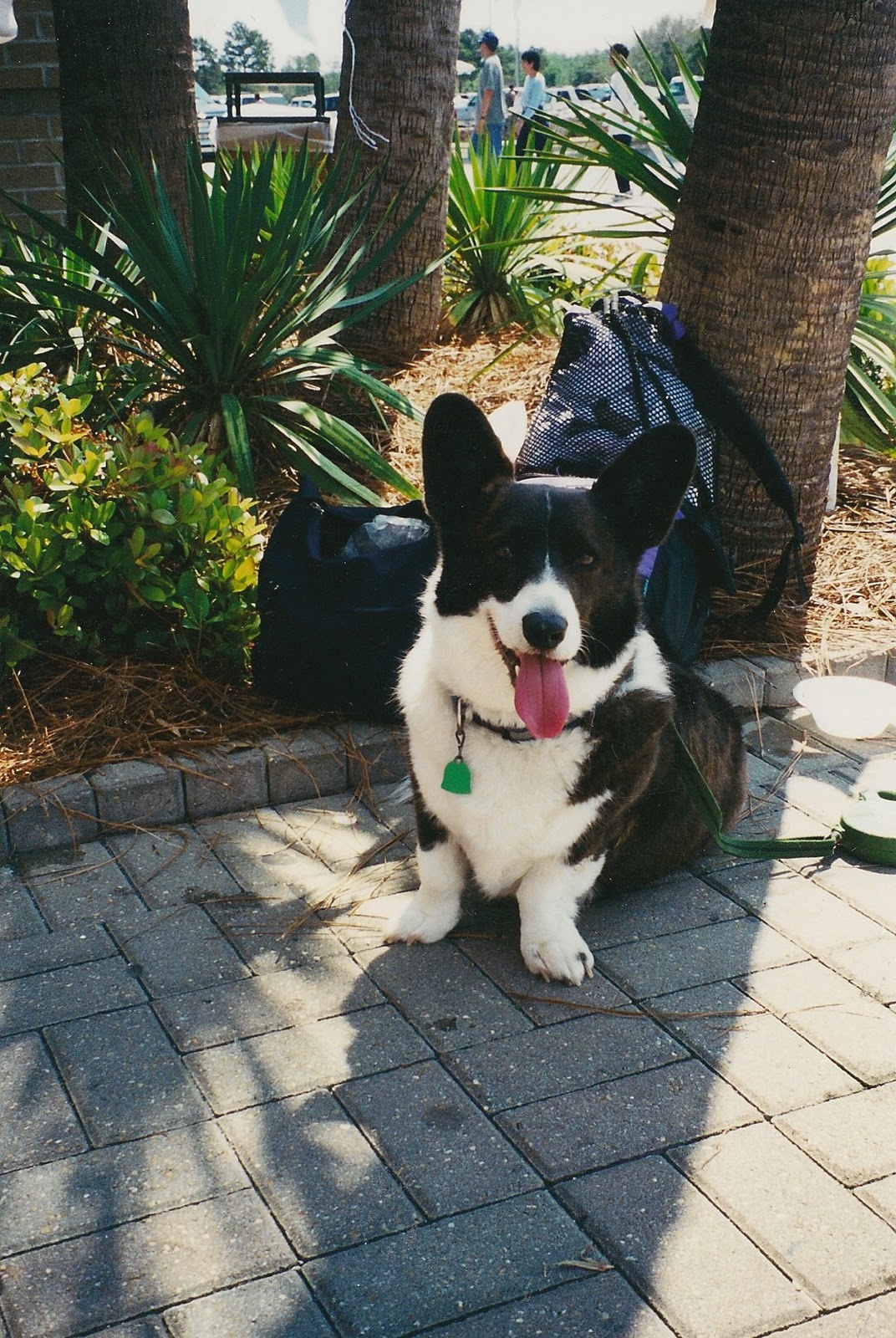
I miss Cardigan Welsh Corgi's -- Around here you can find Pembroke corgi's but not Cardigans.  When we lived in England we bought one for 150 pounds.  He was a great dog!  He hated to travel by car, unless he got to drive, but overall he was pretty perfect in most other aspects.  Except for that time he nipped at me and I had to take him to the vet and get his junk removed.  My daughter taught him several tricks and he was a joy to have.  With the little short legs you didn't worry about him jumping up.  Jumping really wasn't his strong suit, although he did run like a rabbit when he got going.

Well that is about enough things to miss for one night.  I hope you all are enjoying the post Thanksgiving withdrawals and the shopping hasn't gotten you down yet.
Related Posts Plugin for WordPress, Blogger...